
Published: Jun 21, 2026, 12:00 AM · Last updated: Jul 1, 2026, 1:27 AM
Agraria
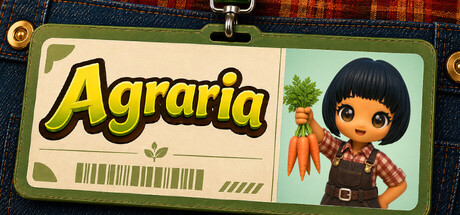
Cozy farming sims are their own overcrowded aisle now, and most of them fail the same way. They promise a quiet life, then bury you in birthday reminders, romance flags, and a plot about saving grandpa's estate from a soulless megacorp. Agraria, a solo project from Possibly Huge slated for June 2026 on Steam, does something sharper. It leans into the megacorp bit. You're not fighting the company. You work for the company. Terms and conditions may apply.
That one decision reshapes the whole thing.
Instead of a Stardew-adjacent town full of NPCs whose approval you need to farm alongside your actual crops, Agraria hands you a Shared Land Partnership Plot from Agraria Inc, a hoe, a watering can, a basket, and six turnip seeds. That's the onboarding. Everything after is trials, ranks, and the slow expansion of a plot you don't technically own. Corporate-cozy is a tone rarer than it should be. Office satire wearing overalls.
The systems list is where it starts to separate from the vibes-only end of the genre. 42 crops split across regular fields, grapes, orchard fruits, and wild finds. Bees, chickens, sheep. Over 100 recipes running through manual canning, dehydration, brewing, and factory-scale production. Multiple fertilizer tiers. Organic soil monitoring for premium grades. Irrigation sprinklers that can carry fertilizer or herbicide loads, which is the kind of small mechanical wrinkle that suggests the sim layer has actual teeth under it, not just a UI wrapper over a timer.
The in-game OS is where the personality bleeds through. PotatOS 2.7 is the diegetic layer: email from your "helpful Agraria Inc. partners," an AgShop for seeds and upgrades, a CM3K professional development track that spans 8 ranks and 47 trials, MarketWatch for price trends and seasonal demand, Plotzo for buying bigger plots, GigFarmer for private contracts from locals. A lot of apps. The joke, and the design, is that your entire relationship to the world is mediated through a corporate intranet. You never walk to the general store because the general store is a browser tab.
Whether that lands as clever framing or as friction depends on execution, and here the solo-dev caveat matters. Possibly Huge is one person. The demo playthrough on the dev's own channel, hosted by Dan, is basically the entire output of the studio in one video. No publisher marketing engine. The trailer and a handful of small creator pickups are the whole current footprint, and most of the community chatter so far is about tone. How much of the corporate satire is real bite, and how much is set dressing.
The seasonal economics angle is worth watching. Agraria Valley has a mild, year-round climate, so seasons don't gate what you can grow, they shift demand and price. That's a smarter model than the usual "spring crops die in summer" cycle, because it turns the calendar into a market signal instead of a hard wall. If MarketWatch actually surfaces predictive data with real granularity, this stops being a cozy game and starts being a light logistics sim wearing a cozy skin. Which is, honestly, the version of the genre I'd rather play.
Power tools, seeder, cultivator, harvester, are all described as "power push." Meaning you're still on the field doing the work, just faster. That's the design bet. Keep the hands-on tactile loop even as your empire scales. Automation exists, but you're never fully abstracted out of the dirt. It's a hard line to hold. Plenty of farming sims lose it around the mid-game when the numbers get too big to touch by hand.
Then there's Lars.
The overeager junior inspector who apparently violates the "no social commitments" promise on the box. The store page warns you about him twice, which reads as a dev who knows exactly what one running gag looks like and is leaning all the way in. Seven radio stations with custom in-game podcasts round out the ambient layer. That's a lot of writing for one person, and it's the kind of thing that either carries the game or drowns it depending on how funny the scripts are.
The comparison points are obvious and unhelpful. Stardew set the ceiling. Everything since has been trying to carve out a subgenre. Some go harder on automation (the Farming Simulator crowd). Some pile onto the cozy-life-sim social web angle, Coral Island and Fields of Mistria being the current examples. Agraria is picking a different fight. Farming sim as workplace comedy, with the sim mechanics pulling real weight underneath. That's a narrow lane, and narrow lanes are exactly where solo devs should live.
It's also why the marketing math is brutal. A generic cozy-farming push on Steam puts Agraria next to fifteen prettier, better-funded competitors sitting on six-figure wishlists. The corporate-satire angle, the diegetic OS, the podcast writing, none of that survives being flattened into a "chill farming game" thumbnail. The audience that actually wants this is specific. Cozy-sim streamers who lean into narrative bits and can riff with Lars on camera. Farming-sim YouTubers who dissect economy loops and irrigation depth. Corporate-satire fans, the Portal ARG crowd, people who read Frostpunk flavor text out loud. Small-channel let's-players who thrive on games with strong voice rather than strong graphics. Reaching those creators individually, at the scale a solo dev can realistically manage, is where infrastructure like CreatorFetch becomes the practical route, filtering for channels whose identity actually matches the game's tone instead of blasting keys into the void.
The risk is the risk every heavily-written solo project carries. The jokes have to hold across dozens of hours. The sim layer has to reward the players who showed up for the numbers. The corporate framing has to stay sharp instead of curdling into "quirky" by hour ten. The upside is that if it works, it works in a spot nothing else really occupies. A cozy farming game where the cozy part is a lie told by your employer is a good premise. Whether Possibly Huge can hold that premise through a full release is the actual question. June 2026 is when we find out.