
Published: Jul 9, 2026, 12:00 AM · Last updated: Jul 19, 2026, 1:22 AM
Be Missed and Remembered: The Letter from Mayoiga
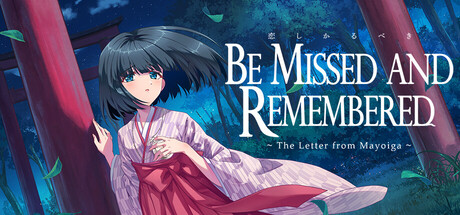
A ghost story that runs on forgetting
The hook of Be Missed and Remembered: The Letter from Mayoiga is a mechanic dressed up as folklore. The Mayoiga, the "Lost House," sits in a mountain nobody visits, underwater most of the time, wrapped in a village curse. Standard rural-horror scaffolding so far. Then comes the amnesia clause. Once you leave, every memory of your time there is gone. So the protagonist walks into a shrine he's clearly stood in before and can't recall a second of it. That's the engine. Loss you can't even mourn, because you don't know it happened.
A Nekoneko Soft project, published by OVERLAP GAMES. Tomo Kataoka, the scenario writer behind narcissu, is credited as both writer and director. Played narcissu? Then you already know the register. Quiet, terminal, more interested in the space around a goodbye than the goodbye.
It lands July 9, 2026 on Steam, July 10 per OVERLAP's own Japanese announcement, so a regional split is likely. It's on Steam now as a wishlist page, demo already out.
Short by design, which cuts both ways
Seven to ten hours. That's the stated total, and the store copy admits the pacing is "tuned to a length that makes you want to binge straight through." Good. Honest. Most visual novels either bloat into a 40-hour slog or refuse to tell you their length at all. This one wants a single sitting.
And that length is exactly what people will fight about. One early write-up sticks it right in the subtitle, a beautiful story that ends too soon. You'll read it either as a tight, deliberate piece with no fat, or you'll finish it in an evening feeling like you paid for a novel and got a novella. Kataoka's narcissu was short too. That was more or less the point of narcissu.
Episodic structure. Full Japanese voice acting. A Gallery mode for revisiting CGs after the credits. "Streamlined controls," which in VN-speak means text-skip, auto-read, and a backlog you'll lean on. None of this reinvents the reader, and it doesn't have to.
The art credits are the real flex
NEKONEKO-SOFT stacked this thing. Character concepts from Werkbau, the artist tied to Christmas Tina, with design help from Hua Juan and Zerui Su. Backgrounds split between KyaruMii and Yumeji Miyoruno. CG by Asanegi Momiji and Ijiyama. Music from project lights. This isn't a one-artist doujin operation. There's a UI designer (KOME WORKS) and a separate logo designer credited on their own.
For a Showa-era rural setting, the backgrounds do a huge share of the mood work. 1972, the "era of moon rockets," the protagonist scoffing at superstition while a mountain full of exposed torii gates says otherwise. If that cicada-drone summer doesn't land visually, the whole nostalgic-dread thing falls apart. Demo footage suggests the studio gets it. But atmosphere in a VN is fragile, and it's the one thing a screenshot can't tell you.
What the demo crowd is doing
Community activity so far is almost all demo-driven and impression-focused, not review-driven, which tracks for a game this far out. There's a cluster of no-commentary full-demo playthroughs and "first 26 minutes" videos, the kind creators post when they want the atmosphere to carry without a mic on top. Telling, that. Nobody's reacting loudly to this. They're sitting quietly inside it.
One creator finished the Switch version and called it great, which points at a multi-platform plan OVERLAP hasn't fully laid out on the Steam page. The Japanese write-ups and the imported-review angle, one review credited to a named critic presented by a separate host, show the audience skews toward people who already follow Japanese VN releases. Nobody in that crowd needs Mayoiga folklore explained.
The distribution reality
Now, a somber story-only Japanese visual novel. No combat. No systems. No roguelike hook. Dropping into a Steam window packed with louder games. A broad marketing spend just evaporates here. You can't buy your way into the general Steam audience with a seven-hour text adventure about memory loss, because the general Steam audience was never the customer.
The people who'll actually buy this are narrow and findable. VN readers who know Kataoka from narcissu. Folklore and Japanese-horror enthusiasts. Translation-adjacent hobbyists who care about the writing above everything. And the slow, quiet no-commentary streamers whose playthroughs are this genre's real word-of-mouth. Reaching those pockets instead of shouting at everyone is the whole difference between launching and vanishing, and that coordination problem is what CreatorFetch works on, matching a niche release to the handful of creators whose audiences are already primed for it.
The Mayoiga legend, the submerged shrine, the 1827-day gap between two people who never bother to trade names. All of it points at a game that lives or dies on how much its ending stays with you after the memories are supposed to vanish. That's hard to pull off in seven hours. Kataoka's done it before. Whether the craft around him is enough this time is the only question worth asking, and we won't know until July.