Published: Jun 24, 2026, 9:03 PM · Last updated: Jul 16, 2026, 6:58 AM
Building a Multi-Platform Influencer Search Workflow Across TikTok, Instagram, and YouTube
Building a Multi-Platform Influencer Search Workflow Across TikTok, Instagram, and YouTube
Most influencer search workflows fall apart at the same spot: the second platform. You build something clean for TikTok, try to bolt Instagram onto it, then YouTube, and a week later you're staring at three spreadsheets, two paid tools, and a Slack thread full of CSVs nobody can reconcile. Handles don't match. Metrics don't either. And the brief has already changed.
So how do you actually run discovery across all three without losing the plot? And where does something like CreatorFetch fit in versus the usual suspects?
Why single-platform searches keep failing you
A creator who crushes it on TikTok is often a different person on Instagram. Sometimes literally a different account. Their YouTube channel might be dormant, or it might be where they actually make their money. Lock your search to one platform and you're seeing a slice.
The data warps too. TikTok's algorithm rewards fresh accounts in ways Instagram's doesn't. Someone with 80k on TikTok and 600k on Instagram is a completely different proposition than the reverse, and a single-platform tool won't tell you which is which.
The fix isn't running three searches and merging later. The fix is starting with a layer that already spans all three.
Define the creator, not the platform
Before you touch any tool, write down what you actually want. Not "TikTok creators in fitness." Something like: women, 25 to 40, posting strength training, US-based, audience skews female and engaged, no MLM ties, willing to do paid partnerships under $2k for a Reel or a short.
That brief works across platforms. "TikTok creators in fitness" doesn't.
When your filters live at the creator level (niche, audience demos, geography, posting cadence, content style), you can apply them the same way no matter where you're searching. That's what makes a multi-platform workflow even possible. It's also why most teams skip this step and then wonder why their shortlists read like a random sample.
Pick one discovery dashboard, not three
This is where tooling actually matters. You can run this workflow on Upfluence or Tagger or Influencity. They all touch multiple platforms, but depth varies and the pricing curve gets ugly fast. Heepsy is leaner, thinner on YouTube. Klear and Traackr lean enterprise. AspireIQ is more marketplace-shaped. NinjaOutreach has been around forever, and looks it.
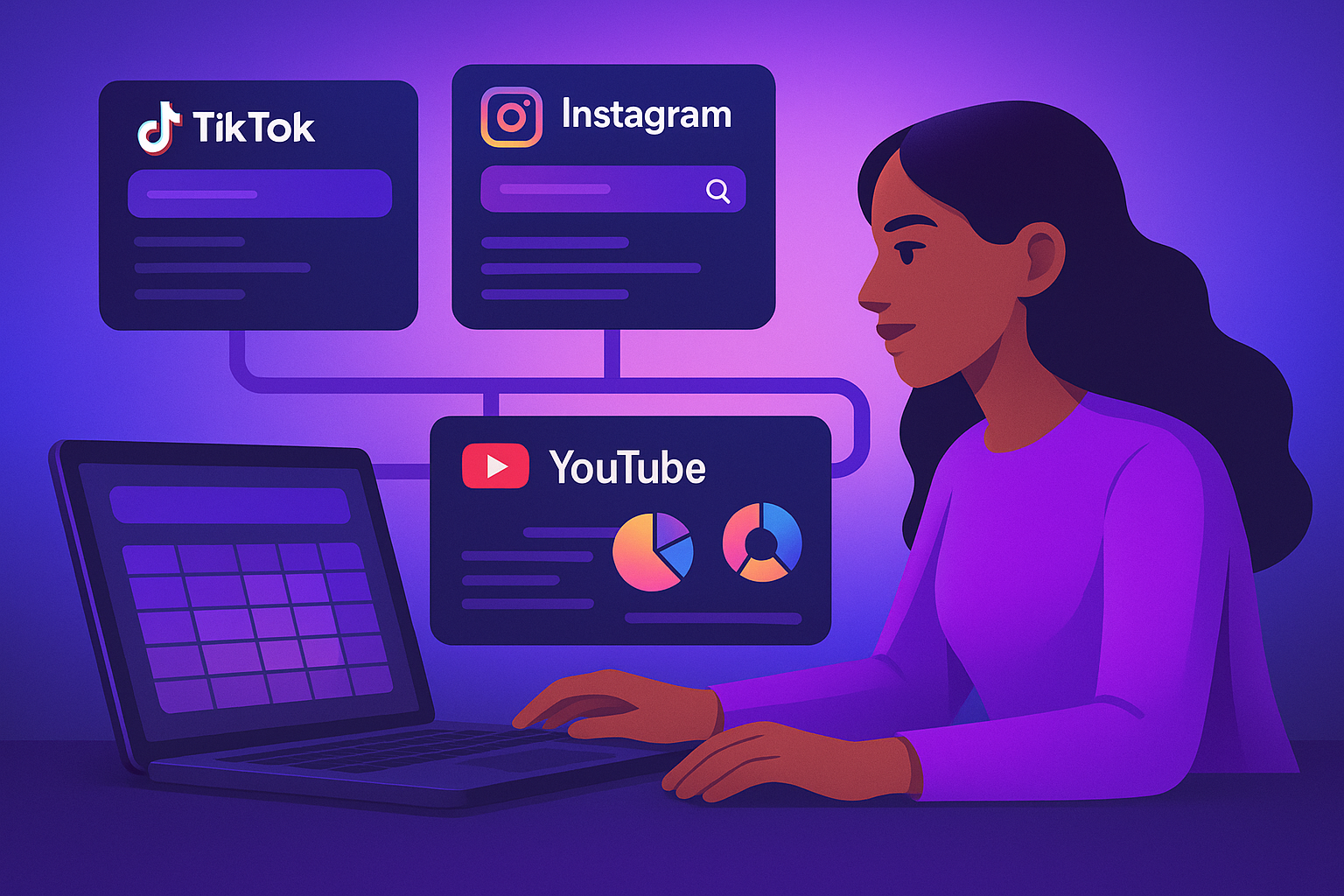
CreatorFetch sits in the discovery-first lane: search TikTok, Instagram, and YouTube from one Influencer Discovery Dashboard, filter by niche, follower count, engagement, and location, pull a shortlist without bouncing through three separate tools. That's the part that saves real hours. Contracts and payment rails matter later, but not here.
Pick whichever fits your budget and team. The point is unification at the discovery layer. Skip that and every downstream step gets harder.
Build the shortlist in layers
Trying to find the perfect creator in one search produces a mediocre list every time. Run discovery in passes instead.
First pass: cast wide. Niche and geography only. You should get hundreds of results. Don't squint at them yet.
Second pass: add audience filters. Age, gender split, audience location. This usually cuts the list by 60 to 80 percent. What's left are the creators whose followers actually match your customer.
Third pass: engagement and recency. Anyone who hasn't posted in 30 days drops. Anyone with engagement that looks suspiciously high, or suspiciously flat, gets flagged for manual review. Bot-inflated accounts are still everywhere. Any halfway decent dashboard will surface them.
By the end of the third pass you should have somewhere between 40 and 120 creators, depending on the niche. That's your working list.
Reconcile the same person across platforms
This is the step everyone forgets. @sarahlifts on TikTok might be @sarah.lifts on Instagram and "Sarah Lifts" on YouTube. Treat those as three separate entries and you'll either pitch her three times (embarrassing) or miss that her YouTube audience is twice the size of her TikTok one (expensive).
A good dashboard merges these into one profile. If yours doesn't, build a manual reconciliation step. It's tedious. Do it anyway. Cross-platform audience overlap is one of the few signals that actually predicts whether a creator will deliver real reach or just inflated numbers on a single channel.
Tier the list before you reach out
Don't email everyone the same thing. Split into three tiers based on fit, not follower count:
- Tier A: strong content match, strong audience match, active on at least two of your three target platforms. Personal outreach.
- Tier B: good on one platform, decent on another, audience mostly aligned. Standard outreach with a tailored hook.
- Tier C: edge cases, smaller creators, or one-platform specialists worth testing. Batch outreach, lower effort.
Tier A is where the real time goes. Tier C is where you learn things. Sometimes a micro-creator with 12k engaged followers smokes a 400k account, and the only way you find that out is by testing.
Where the workflow usually breaks
Two places.
First, the handoff. Shortlist goes to the outreach person and the context evaporates. Why each creator made the cut, what their best content looks like, which platform they're strongest on, all of it gets stripped down to a name and an email. Keep the context attached. Future-you will say thanks.
Second, reporting. If you discovered across three platforms, you have to measure across three platforms. TikTok views, Instagram saves, YouTube watch time. These don't map cleanly. Pick the metric that matters most for the campaign goal upfront and hold the line across all three. Pretending a TikTok view equals a YouTube view will make your post-campaign deck shine and your next campaign worse.
The honest take on tooling
No tool does everything well. The enterprise platforms have deep data and a learning curve that'll eat a junior marketer alive. The lean ones move fast and miss creators. CreatorFetch is on the fast-and-unified side for discovery, which happens to be the part of the workflow that benefits most from being in one place. If your bottleneck is contracts, payments, or attribution, look elsewhere, or add something on top.
Buy for your worst current problem. If finding creators across three platforms eats a week, start with a unified discovery dashboard. If you're trying to pay 80 creators a month, that's a different tool entirely.
The workflow above survives most of them. The tool just decides how painful step two gets.
Written by the CreatorFetch.com editorial team.