Published: Jun 20, 2026, 8:20 AM · Last updated: Jul 16, 2026, 6:58 AM
Creator Discovery vs. Influencer Search: Which Approach Wins for DTC Brands
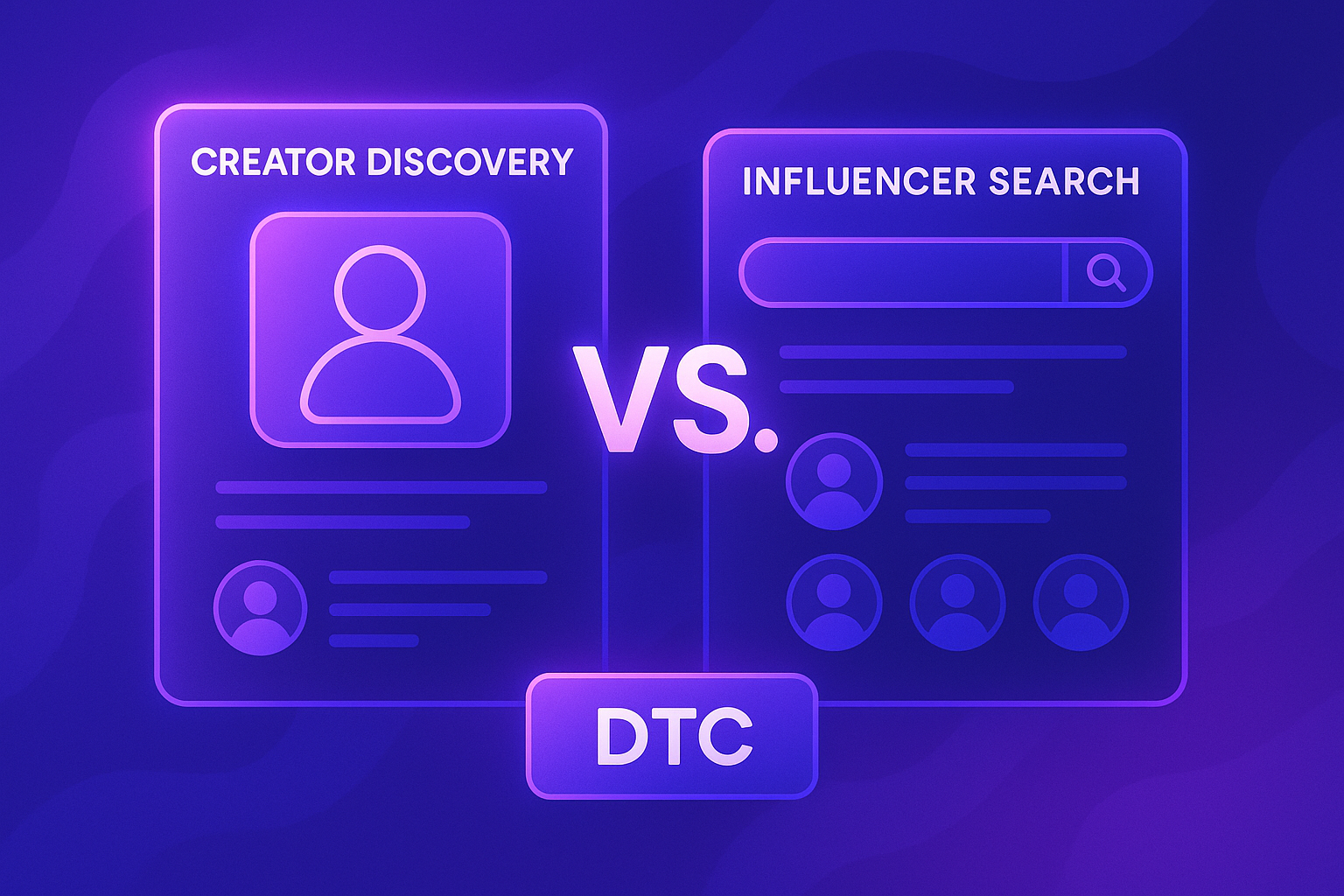
Creator discovery vs influencer search: which one actually wins for DTC
The language has shifted. Three years ago everyone said "influencer search." Now half the agency decks and half the SaaS landing pages say "creator discovery." Same thing?
No. And if you're running growth at a DTC brand, the difference shows up in your seeding budget faster than you'd think.
What influencer search actually is
It's the old model. Open a database, filter by follower count, geo, category, engagement rate, export the list. Heepsy, NinjaOutreach, the older Upfluence and Klear flows, they were all built around this. You're hunting by metadata. 50K to 200K followers, beauty, US, 3% engagement. Done.
It works. Kind of.
The issue is that the filter stack rewards whoever has gamed the metrics, not whoever moves product. I've watched a DTC team ship $8K of free skincare to a "perfectly qualified" creator and walk away with one Story slide and two link clicks. Numbers checked out. Fit was wrong.
Where discovery flips it
Creator discovery starts from the other end. Instead of "who matches these filters," the question becomes "who's already talking about products like mine, in a voice that sounds like my best customers?" The inputs are content, context, audience overlap. Not just tier and ER.
That's why tools like CreatorFetch, Tagger, and parts of Traackr have drifted toward a different shape. The Influencer Discovery Dashboard model, built around what creators actually mention, how they sound, when they post, and how their audience overlaps with adjacent brands.
Why DTC feels this more than CPG
A big CPG brand can test 200 creators a quarter and tolerate a 70% miss rate. A DTC brand running on a $4M marketing budget can't. Every gifted unit has COGS. Every paid post has a CAC implication. Bad matches aren't abstract, they're line items.
So the question is operational, not philosophical. Which approach gives you a higher hit rate per hour of work, per dollar of seeding?
In my experience: search wins when you already know the archetype that converts and you're just refilling the bench. Discovery wins when you're entering a new category, launching a new SKU, or trying to break out of the same 12 creators every competitor in your category is also paying.
Both sides break in their own way
Search-first tools miss nuance. A creator tagged "fitness" might be 80% mom content with a Peloton in the background. The filter has no idea. You find out on the discovery call.
Discovery-first tools have the opposite failure: surfacing creators who are a beautiful content fit and a terrible commerce fit. Vibes aren't purchase intent. The better dashboards fix this by layering audience data on top of content data, so you see who the creator is and who's actually watching.
Influencity and AspireIQ live somewhere in between, more workflow than discovery engine. Klear is analytics-heavy. Heepsy is fast and cheap and shallow. None of them are wrong. They're just built for different jobs, and pretending one tool covers all of them is how you end up paying for three.
A rough split
Use search when you have a proven profile and you're scaling volume. You know the archetype works. You need 40 more of them.
Use discovery when you're launching, repositioning, or your roster has plateaued. This is where a real dashboard earns its money, surfacing creators you wouldn't have filtered for because you didn't know the filter existed.
Most brands need both. Honestly. The mistake is paying for two tools that do the same job and calling it a stack.
What actually matters in the tool
A few things that punch above what the marketing page tells you:
- Data freshness. A creator index updated quarterly is basically fiction in 2025.
- Can you search by what creators say, not just who they are? Keyword-in-content is the most underrated feature in this whole category.
- Audience overlap with brands you already know convert. If a creator's audience overlaps 40% with three winners in your category, that's worth more than their ER, full stop.
- Outreach and tracking in the same place (otherwise discovery dead-ends in a CSV and someone's Gmail).
That last one is where DTC teams quietly lose hours every week. Discovery in one tab, Gmail in another, a Notion tracker in a third, and a shared Sheet nobody updates. Whatever ties those together is the tool that actually saves time, whether the marketing page calls it influencer software or a creator platform.
So, which one wins
Discovery wins for most DTC brands right now. Not because search is dead. It wins because the creator economy got too big and too fragmented for filter-based hunting to cover enough ground. The creators worth your seeding budget probably aren't in the top results for "beauty, US, 100K." They're three layers deeper, and you only find them by following content and audience signals into corners the filter doesn't reach.
If you're rebuilding your creator program for next year, start with discovery, use search to scale what works, and pick one dashboard that does both without forcing you to live in spreadsheets. CreatorFetch is worth a look if that's the stack you're trying to put together.
Written by the CreatorFetch.com editorial team.