
Published: Jul 14, 2026, 12:00 AM · Last updated: Jul 16, 2026, 12:25 AM
Factory Town 2: Paradise
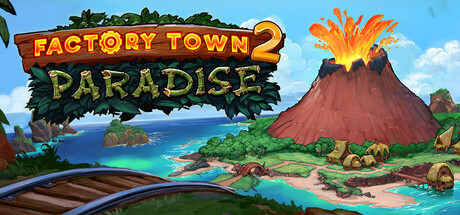
The volcano wants your surplus, and that's the smartest hook in the genre right now
Factory sims live and die on their loop. You produce, optimize, feed the machine, scale. The hard part every designer wrestles with is what sits at the top of that pyramid. The thing that actually consumes what you've built. Most games hand you an abstract "science" counter, or a rocket that eats resources into the void. Factory Town 2: Paradise puts a giant, friendly volcano deity there instead. It's a better answer than it sounds.
Erik Asmussen is back with the follow-up to the original Factory Town, which found a real audience among people who like their belts and their bottlenecks without a horde of enemies breathing down their necks. This one lands July 14, 2026 on Steam. It keeps the no-fail-state philosophy and drops everything onto a chain of tropical islands.
The pitch is simple. You land on a deserted island, plant houses and farms, townspeople show up and start doing the grunt work, and you spend the rest of your time untangling supply chains with conveyors, trains, boats, zip lines, pipes, and, yes, catapults. Feed items into the volcano and it hands back recipes, tech, upgrades. It'll even raise new islands out of the ocean when you're out of room. That last bit is the clever one. It ties expansion directly to your output instead of letting you sprawl wherever you want, so the map grows as a reward rather than a given.
Two genres bolted together, and the seams matter
The town-builder-plus-factory-sim hybrid has a built-in problem. Those two genres pull in opposite directions. A town builder wants you managing people, moods, needs, the soft stuff. A factory sim wants you obsessing over throughput and ratios and the exact spot where your iron plates back up. Games that try both usually nail one and treat the other as decoration.
Factory Town 2 seems to be leaning hard the other way. Every item you produce carries worker-boosting stats. So the tropical drinks, pastries, ice cream, coffee, clothes, jewelry, books, medicine, potions, none of them are just checkboxes on a needs list. What you choose to manufacture feeds back into how well your townspeople perform, which loops back into your production capacity. That's a real design decision, not filler.
Whether it survives a 40-hour save is the open question. These systems tend to collapse into one dominant strategy the second players find the optimal item.
The water stuff is where the engineering brain gets fed. Volumetric water physics, actual trench-digging and dam-placing to route springs from the mountains down to farms and reservoirs. Waterwheels and windmills spin drive shafts that boost processing or generate electricity, and that power runs down lines to refrigerators and furnaces. Layer a day/night cycle on top and you've got a genuinely deep systems stack, assuming the simulation runs clean and doesn't turn into a slideshow once you've got three islands humming at once. Performance is the thing to watch with voxel factory games. The item counts get absurd fast.
What the demo crowd is fixated on
The demo has already made the rounds with the factory-game YouTube circuit, and the reactions cluster around a few things. The voxel art keeps getting called charming rather than cheap, which matters in a genre that often looks like a spreadsheet with textures. The volcano-cult framing, feeding offerings to a sentient mountain god, is clearly landing as the personality hook that separates this from the fifty other belt games sitting on wishlists. And the relaxation angle keeps coming up. No penalty, no clock, build at your own pace. That's the reputation the original built.
Here's the tell. Reviewers poking at the demo aren't asking "is this fun." They're asking "how does this improve on Factory Town 1." Which tells you who's actually watching. Returning players and genre lifers, not curious tourists. That matters for how the game gets sold.
The controllable avatar is a quiet gamble
One line in the feature list is easy to skim past. A controllable avatar. The original was largely a hands-off god game where you placed things and watched them work. Give the player an actual character to run around with and the moment-to-moment feel changes. It either makes the world feel more alive or it adds a walking-simulator tax to setting up your next assembly line. I'd want a lot of hands-on time before calling it. It's the kind of feature that reads great on a Steam page and plays out very differently depending on how hard the game leans on it.
Why a broad marketing blast would waste this launch
Factory Town 2 is not a game you sell to everyone. Pretending otherwise burns money for nothing. The automation-sim audience is specific, opinionated, and deeply skeptical of surface-level hype. They've been trained by Factorio, Satisfactory, Dyson Sphere Program, and a dozen colony managers to smell shallow systems straight from the trailer. A generic wide push, banner ads, algorithm-chasing, mass influencer drops, gets ignored by exactly the people most likely to buy and evangelize something like this. The realistic path for a solo-developer-scale project is narrow and deep. The factory-optimization creators whose viewers sit through four-hour belt-routing videos. The cozy-builder streamers who care about the no-fail-state design. The systems-breakdown channels that dissect production ratios for fun. Reaching precisely those categories, at the volume and timing a Steam launch demands, is where infrastructure like CreatorFetch fits, matching a niche title to the creators whose audiences already self-selected into caring about conveyor belts and water physics, instead of spraying the message at a crowd that'll scroll right past it.
The original earned its "best-selling" tag by respecting a specific kind of player. Someone who finds peace in fixing a bottleneck at 1am. Paradise looks like more of that, with better water, a volcano with a personality, and a town layer that might actually feed the factory instead of decorating it. The risks are the usual ones. Late-game performance, whether the item-stat system stays interesting once it's solved, and whether that avatar earns its place. July 2026 is a way off, and demos flatter. But as a follow-up that knows exactly who it's for, this one's aimed straight.