
Published: Aug 26, 2026, 12:00 AM · Last updated: Sep 3, 2026, 12:35 AM
Folk Emerging
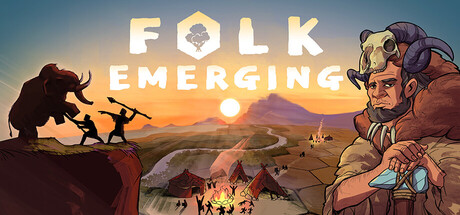
A 4X game that starts before the city, not after it
Most 4X games hand you a settler, a patch of grass, and a nudge to plant your capital by turn three. Folk Emerging won't do that. It drops you back into the stretch of human history nobody makes games about. The hundreds of thousands of years we spent wandering with no walls, no fields, and no guarantee our great-great-grandchildren would even happen.
Curious Dynamics is building it as turn-based strategy where "expand" doesn't mean paint the map your color. It means keep a band of hunter-gatherers breathing while they migrate through climates that want them dead. It's on Steam, dated for August 2026, with a demo already out that a handful of strategy streamers have gotten their hands on.
The pitch is ambitious to the point of being slightly worrying. I mean that as a compliment.
Where the simulation actually lives
The hook isn't the tech tree, even though there's one, running from controlled fire and cooking through domestication all the way to megalithic construction and the first cities. Every 4X has a tech tree. What's harder is the thing they're staking the whole design on. Deeply simulated individuals, heritable traits, spread across generations.
So a warrior isn't just a warrior. Lose one in a skirmish and you don't drop a unit with an attack stat. You lose a hunter, somebody's parent, a person who carried knowledge the tribe can't get back. That's the kind of line a lot of games print in marketing copy and then never actually model. The real question, the one the demo exists to answer, is whether the systems underneath make you feel that loss or whether it's flavor text bolted onto ordinary casualty math.
Combat is autobattler-style. You tune your composition beforehand, then watch it play out. Smart call for a game this focused on consequence. You're not twitch-microing soldiers. You're betting real people's lives and then living with the result.
The ecology is where it gets genuinely strange. Nine climates, each with its own food web, on procedurally generated Earth-like maps built from realistic climate simulations. Resources run out. Extraction changes the environment. Overhunt the megafauna and nature doesn't fire off a polite warning. It just collapses on you.
Most strategy games gesture at that loop and then quietly drop it, because balancing a real ecosystem is a nightmare. If Curious Dynamics pulls it off, this becomes one of the few 4X games where the map is an actual antagonist and not terrain with resource icons scattered on top.
The press kit is thin, the pitch is not
There's no proper website. Just a Google Drive press kit with the usual artwork, logos, screenshots, and a fact sheet PDF dated mid-2025. The demo has its own separate Steam app ID, worth knowing if you go looking, since the demo trailer points to a different page than the main store listing. Not a red flag. Just the sort of thing that trips people up when a studio splits the demo out.
The social network visualization is the feature I keep circling back to. Dynamic family trees, relationships between band members rendered as a graph you actually manage. In a game about generations, that's not a gimmick, it's the interface you'll live inside. Whether it stays readable once you've got dozens of interconnected people is something no screenshot can tell you.
Who's actually watching this
The early coverage tells you exactly who this is for. The creators poking at the demo are the deep-strategy crowd. The people who narrate their turns and light up over systems. And the pattern in their content says a lot. One decided to recreate Sumer. Another went for a pre-dynastic Egypt run and then eyed the Sumerians too. They're not playing the tutorial. They're using the sandbox to tell historical stories and stress the simulation until something interesting breaks. First-impressions videos keep picking at the ecology and the generational mechanics specifically, which is the right instinct, because those are the parts that either carry the game or sink it.
That audience is small, loyal, and impossible to fool. They've played every grand strategy title going back decades, and they can smell a shallow system in one stream.
The marketing math
Here's where the studio has to be honest with itself. A game about paleolithic nomad genealogy and dynamic food webs is never winning a broad marketing push, and trying would just set money on fire. The mass-market strategy buyer wants to found Rome and paint the map purple by hour two, not manage the heritable traits of a hunting band across ten generations while the local deer population crashes.
So survival depends on reaching the exact niche already showing up in the demo coverage. The historical-sim streamers who roleplay ancient civilizations. The 4X and grand-strategy YouTubers who dissect systems for thousands. The smaller ecology-and-simulation channels where a properly modeled food web is a selling point, not a footnote. Getting the right build into those specific hands, at the right moment before the August 2026 launch firehose drowns everyone, is basically the whole game for a studio this size. CreatorFetch is the kind of infrastructure that runs that hyper-targeted creator outreach instead of praying the algorithm notices.
What's here is a bet on depth over accessibility. Hard bet to win, easy one to respect. The demo is the honest test. If the generational weight lands and the ecosystem actually bites back, this could be the rare 4X that finds something new by looking further into the past than anyone bothered to. If it doesn't, it'll be another beautifully ambitious systems pitch that couldn't quite close. Worth watching either way. And for once I mean that literally, since the streamers are already doing the watching for you.