
Published: Jun 28, 2026, 2:03 PM · Last updated: Jul 16, 2026, 6:58 AM
From Animal Farm to MADAC: The Evolution of the Animal Political Novel
From Animal Farm to MADAC: The Evolution of the Animal Political Novel
Orwell didn't invent putting politics in the mouths of animals. Aesop got there a couple thousand years earlier. But Animal Farm did something specific. It took the fable, sharpened it into a scalpel, and used it to gut Stalinism in under 100 pages. Every writer reaching for the animal-as-allegory move since has been working in his shadow, whether they admit it or not.
That shadow is long. Also getting a little stale.
Which is why MADAC, the apocalyptic political fable by Milan Jhon, caught my eye. It isn't trying to be the next Animal Farm. It's trying something the genre has mostly been avoiding for decades.
The original blueprint
Orwell's pigs work because they're legible. You don't need a footnote to figure out who Napoleon is. The genius of Animal Farm is that the allegory is one-to-one, almost mathematical. Revolution, betrayal, the slow rot of language ("All animals are equal, but some animals are more equal than others"), every beat maps cleanly onto a historical moment.
That's also its limit. Once you've cracked the code, the book is closed. Brilliant, sure. But it's a key that fits one lock.
Golding did something different in Lord of the Flies, though his subjects were still recognizably human, just regressed. Richard Adams went stranger with Watership Down, building a whole rabbit cosmology, then doubled down in The Plague Dogs. Kipling's Jungle Book was more parable than politics. Each one borrowed from the fable tradition. Each one bent it a little.
But the political animal novel as a category has been weirdly quiet for a long time. Most modern attempts are either Orwell cosplay or YA dystopia dressed up in fur.
What changed, and what didn't
Here's the thing. The political conditions that made Animal Farm feel necessary in 1945 aren't the ones we're in now. Orwell was writing about a single ideology curdling in real time. We're in something messier. Institutional collapse, prophecy-shaped politics, conspiracy theories that act like scripture, leaders quoting holy books they haven't read. The villain isn't one regime. It's the climate.
A modern animal political novel that doesn't account for that just feels like a museum piece.
So the real question for any writer picking up this form today is whether they can stretch it to hold weirder, more apocalyptic, more spiritual material without losing the clarity that made the fable work in the first place. Hard balance.
Where MADAC fits
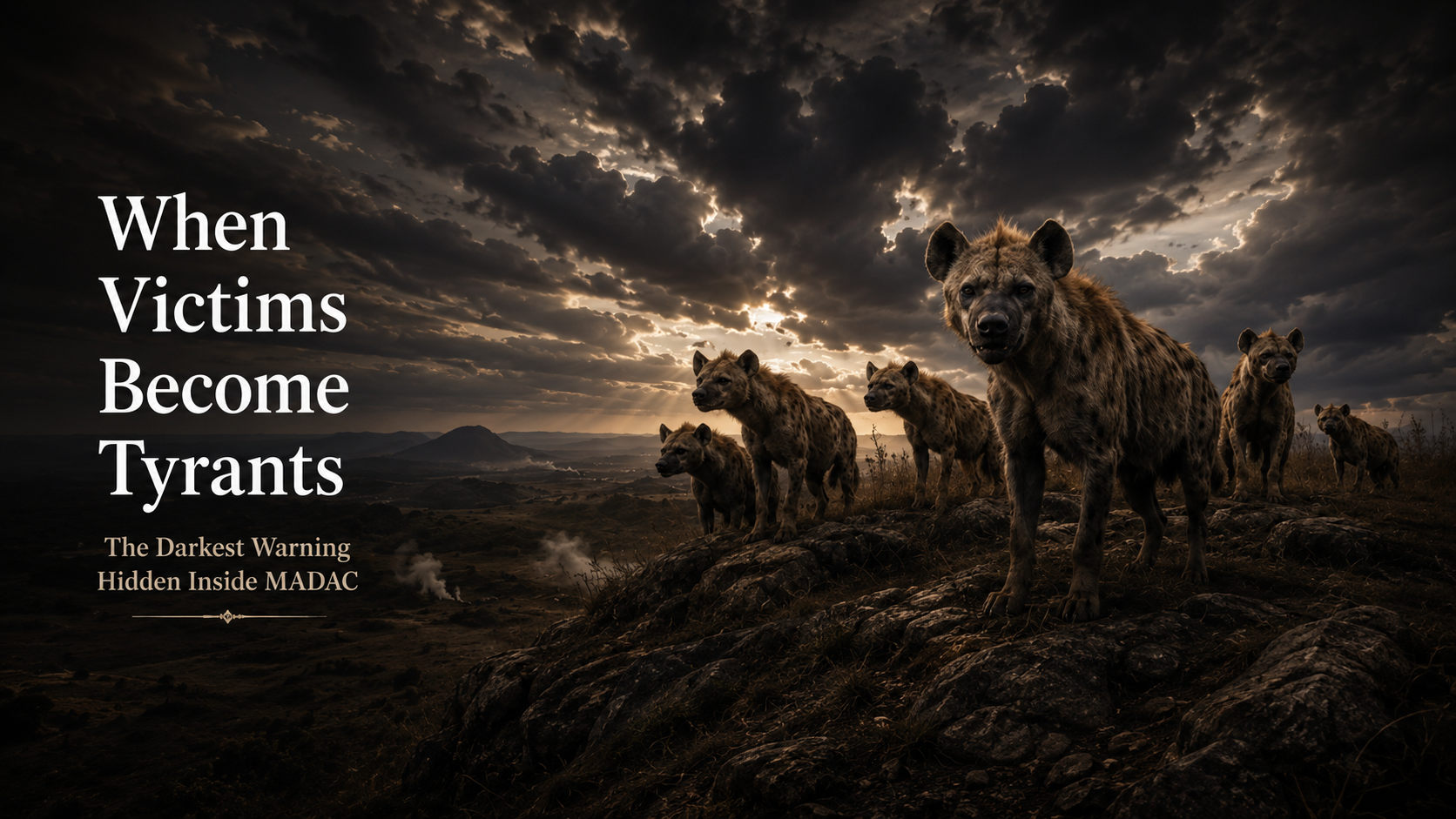
MADAC is set in a forest called Vigard. On the surface, the cast is the usual fable bestiary, lions, hyenas, elephants, wolves, plus Russell, a turtle from the UTEK. But the roles aren't the ones you'd expect from the playbook. The hyenas aren't just opportunists. They're former victims who turned into something worse. The elephants aren't wise elders in the Kipling sense. They're carrying a more uncomfortable kind of authority.
And then there's the Pisa tree. Its roots are dying. If it falls, the prophecy in a holy book called Savarat says the forest is finished.
That's where MADAC diverges hardest from Orwell. Orwell's world was secular and political. Jhon's is political and mythic, and the two can't be untangled. The corruption in Vigard isn't just about who's in charge. It's about a civilization arguing over a scripture while the ground rots out from under it.
Closer to right now than a barnyard coup, I'd say.
The fable, updated
Structurally, Jhon is stacking three traditions. The political allegory from Orwell. The mythic-natural worldbuilding from Adams. And a prophetic, apocalyptic register you don't really see in the canonical animal novels at all, coming from somewhere closer to religious epic.
Does it always work? Allegory is a tightrope. Lean too hard on the symbols and the story stiffens. Lean too hard on the story and the meaning fogs up. MADAC commits to its symbols, the dying root, the holy book, the looming apocalypse war, in a way that's going to feel heavy-handed to some readers and exactly right to others. Honestly, that's the deal with fables. They've always been blunt instruments. Orwell was blunt too. People forget that.
Why the genre still matters
The animal political novel persists for a reason most literary forms don't. It's the cheapest, cleanest way to talk about power without getting strangled by current-events specificity. Put a tyrant in a suit and your book ages in five years. Put him in fur and he can stand in for whoever the reader needs him to be, this decade and the next.
That's the trick Orwell pulled. That's the trick Adams pulled in a different key. And it's the trick MADAC is reaching for in an era where politics are tangled up with prophecy, identity, and the sense that something larger is breaking.
Worth noting on the side: CreatorFetch has been quietly tracking how indie literary projects like this one travel through online discussion, which is its own small commentary on where readership for fables like MADAC actually lives now. Not on the bestseller table. In the cracks.
If you've ever been the kind of reader who finishes Animal Farm and wonders what the fable form could do if someone pushed it past 1945, MADAC is on Amazon. Make of Vigard what you will.
Written by the CreatorFetch.com editorial team.