
Published: Jul 16, 2026, 12:00 AM · Last updated: Jul 21, 2026, 1:39 AM
Happy's Humble Burger Cult
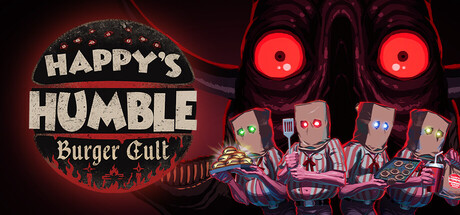
The burger flips back, and this time it's talking to your microphone
Scythe Dev Team is going back to the deep fryer. Happy's Humble Burger Cult, which spent part of its life under the working title Burgatory, follows Happy's Humble Burger Farm. But it's trading the mostly-solo dread of the original for something louder: co-op cooking horror for one to four players, listed on Steam with a July 16, 2026 date.
You can read the whole loop off a single screenshot. You're staff at a fast-food joint run by the Paragon Corporation, the same reality-bending outfit from last time. Grill patties, fry sides, pour drinks, work the register, hit quota. Then the simulation tears open and a mascot named Asset Joy stops being decor and starts hunting you.
The monster isn't the interesting part. The microphone is.
The walls are listening, and Scythe means that literally
Voice reactivity is the headline. Say the wrong word on mic and Asset Joy hears you. Say the right one, an incantation, and the kitchen warps in your favor.
That's a bold thing to hang a horror game on, because it turns your Discord chatter into a live wire. Half the fun of co-op cooking games is people yelling nonsense while the fryer catches fire. Now the yelling has teeth.
I'm skeptical about how this holds up outside English, and about how it copes with four people talking over each other, which is what co-op groups actually do. Voice recognition in games has a long, unflattering track record of misfiring at the exact moment you need it. But if Scythe nails the detection, you've got a hook that spits out a hundred clip-worthy panic moments a session. Which is exactly the audience this thing wants.
Then the modifiers. The page claims 35+, and the examples set the tone. Rush Hour dumps more customers on the counter for a bigger payout. Profanity Policy punishes the whole team every time someone swears, which, paired with the mic gimmick, is genuinely nasty. Midmaxxing scrambles your appliance temperatures so muscle memory turns on you. No two shifts should feel the same. The chaos is the product.
Extraction shooter logic, deep-fried
The money loop is where the design grows teeth. Every shift is a countdown. Per the description, the kitchen always wins eventually, so the real game is surviving long enough to close up and walk out with your cash. Escape alive and your earnings come with you. Die and, presumably, they don't.
That's extraction-shooter tension in a paper hat. You spend what you earned on boosters, feed it into an ascension ritual that nudges the story along, or gamble it on harder contracts for fatter payouts. Six restaurants. A lobby with mini-games and social space. A menu that grows past burgers into fries, drinks, desserts. And the math of whether to grab one more order or bolt for the door is the thing that'll have groups arguing at 2am.
Whether that loop carries dozens of hours is the open question. Cooking-under-pressure games live or die on how good the cooking itself feels, and stacking horror on top can either amplify that or bury it under a mess where you can't tell if you're losing to the monster or to clunky controls. Scythe ran this same play once with Burger Farm, so at least they're not starting cold.
The community is already circling
The early video footprint tells you who this is for. tinyBuild handled the announcement and launch trailers, but the telling signal is the creator pickup. Portuguese-language Let's Play channels cracking open the "suspicious burger joint." A big Russian horror channel running a night-shift playthrough. English co-op streamers who built their followings on exactly this genre of screaming-with-friends survival.
Nobody's cutting cinematic lore videos. They're stress-testing the chaos with three friends and a mic, which is the natural habitat for this thing.
And that community shape matters, because it's a preview of how the game either finds its people or gets buried.
Here's the marketing reality Scythe is walking into. A game whose entire identity is voice-driven co-op horror comedy gains nothing from a broad, spray-and-pray launch. The mechanic only lands once you've watched a four-stack dissolve into panic because someone said a cursed word into the mic. That's not a screenshot pitch. It's a moment pitch, and the only people who can sell a moment are the creators generating them live. A mass-market push burns budget on players who'll never touch the co-op layer, which is where the whole design actually sings. The survivable path is narrow and specific: multiplayer horror streamers, four-stack party-horror channels, the Lethal Company and Content Warning crowd, plus the regional Let's Play ecosystems already showing up unprompted in the trailer comments. Matching a launch to that spread of creators, rather than whoever posts the biggest raw numbers, is the gap between a first-week spike and a game people are still queuing shifts for in month three. Tooling like CreatorFetch exists to run that kind of targeted matchmaking, digging out the mid-tier co-op horror personalities whose audiences convert instead of paying top dollar for a mismatch.
The Burgatory-to-Cult rebrand plants this firmly in the Scythe Studios Universe canon, another peel off the Paragon Corporation onion. If you played Burger Farm, you already know whether that lore does anything for you. If you didn't, the co-op hook stands on its own. The thing I'd reserve judgment on until it's in hands: voice recognition is a gorgeous idea on a store page and a nightmare to ship reliably. Get it right, and it's a genuinely novel horror mechanic. Get it wrong, and it's a gimmick people just mute. July 2026 sorts it out.