
Published: Sep 2, 2026, 12:00 AM · Last updated: Sep 3, 2026, 2:40 AM
He Who Watches
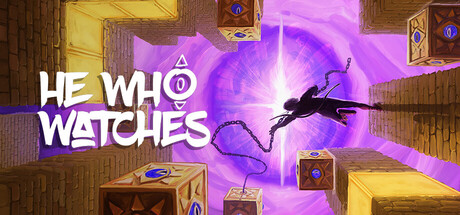
A bow that never fires an arrow at anything living
You carry a bow. You have one arrow. And the whole design hangs on the fact that you never shoot a monster with it. That arrow is a wrench, a grappling hook, a switch-flipper, all in one, and it's the beating heart of what He Who Watches is going for.
It's a first-person puzzle game about gravity turning on you. Walls become floors. Ceilings become paths. You slide between planes and the world flips under your feet, which is the sort of mechanic that clicks instantly or leaves you glued to a wall trying to work out which way is down. Solo dev Bobby Vanden made it. Draknek & Friends, the studio behind a run of well-regarded logic puzzlers, is publishing it. That last detail matters more than it looks, and I'll come back to it.
It's on Steam now with a September 2026 window and a demo already out.
Grid movement in first person shouldn't work
Most first-person puzzle games run away from grid movement. Free-look, free-walk feels natural, so that's what everyone reaches for. Vanden did the opposite. Movement snaps to a grid.
Sounds restrictive. It's actually the only way the gravity trick survives as a puzzle instead of a physics headache. When every surface is a discrete cell and any plane can become the floor, you need clean, predictable positioning, or the whole thing collapses into guesswork.
Creators picked up on this quick. Early demo playthroughs kept landing on the same reaction: this doesn't move like anything they'd touched before, and the wall-walking plus grid combo makes you re-plan your spatial logic every few steps. One puzzle-focused streamer spent a whole session just learning to trust that a wall was safe to stand on. That's the pitch and the wall people bounce off, at the same time.
Over 100 handcrafted puzzles, per the store page, each leaning harder than the last. And Vanden was blunt about it, no generative AI in development. In a genre where a human brain has to verify every puzzle is actually solvable, that's not a bumper sticker. It's basically the job. AI-assisted or procedural puzzle design tends to spit out chambers that technically work but feel arbitrary. Handcrafting is the honest way to promise difficulty that ramps on purpose.
The hint system says he knows his own game is brutal
There's a playable hint system built in. Not a tooltip. A playable one.
Small thing, tells you a lot. Vanden expects you to get stuck, badly, and instead of pretending that won't happen he hands you a way through without breaking the fiction. Puzzle games live or die on this. Too generous and there's no payoff. Too stubborn and people quit at chamber twelve and never open it again. Putting the hint inside the play space instead of a menu reads like someone who's watched enough players rage-quit puzzlers to design around it.
Then there's the secrets angle. Hidden mechanics, cryptic symbols, paths tucked into corners. The whole "imprisoned god at the centre" framing gives the labyrinth a reason to keep unfolding. Whether the story pays off is the open question. Atmospheric puzzle games love to promise a mystery at the core and then hand you a slightly disappointing room with a door in it. I'm holding off there until people who aren't playing a demo get the full thing.
Should run on modest hardware
Draknek's catalog leans clean and stylized, not photoreal, and He Who Watches follows that from what the demo shows. Geometric, atmospheric, not GPU-melting. Which is good news if you're on a laptop or something Deck-class, because a grid-based first-person puzzler doesn't need a monster rig the way a shooter does. The strain here is on your brain, not your graphics card.
A shotgun marketing blast would waste this thing
A game like this dies in a mass-market push. It's a niche of a niche, a first-person gravity puzzler, grid movement, no combat. Throw it at a broad audience and you're paying to reach thousands of people who'll refund it in twenty minutes because there's nothing to shoot.
The realistic move for a solo dev, even one with a sharp publisher, is narrow and deep. The spatial-reasoning crowd. The people who make blind puzzle-solving videos. Streamers whose entire channel runs on Antichamber and Portal and The Witness comparisons. The "watch me struggle, then break through" creators whose viewers turn up specifically for that a-ha moment, and those are the exact viewers who convert into wishlists. That's where something like CreatorFetch fits, letting a small studio actually find that hyper-specific band of puzzle creators instead of burning a tiny budget spraying trailers into the wrong feeds during the September launch firehose.
The demo is doing the one job it has, which is convincing skeptics the movement isn't a gimmick. And that's the whole game riding on a single question: does walking on the ceiling stay interesting for 100 puzzles, or does it turn into a chore by the fortieth? Draknek's name buys credibility. The no-AI, handcrafted approach buys goodwill from the exact audience most likely to care. Now it has to stick the landing a year out. If you like the feeling of your brain physically reorienting itself, watch it. If gravity puzzles make you seasick, this one's going to find out fast, and better in the demo than after you've paid.