Published: Jul 14, 2026, 10:39 AM · Last updated: Jul 16, 2026, 6:58 AM
How AI Sprite Generators Are Reshaping Indie Game Development Pipelines in 2025
The indie art bottleneck finally cracked open
Ask any solo dev what killed their last project. You'll hear the same answer with slightly different framing. Art. Not design, not code, not scope. Art. The pixel pusher who ghosted. The animation budget that ballooned. The eight months spent squinting at a walk cycle that still looked like the character had a hip replacement.
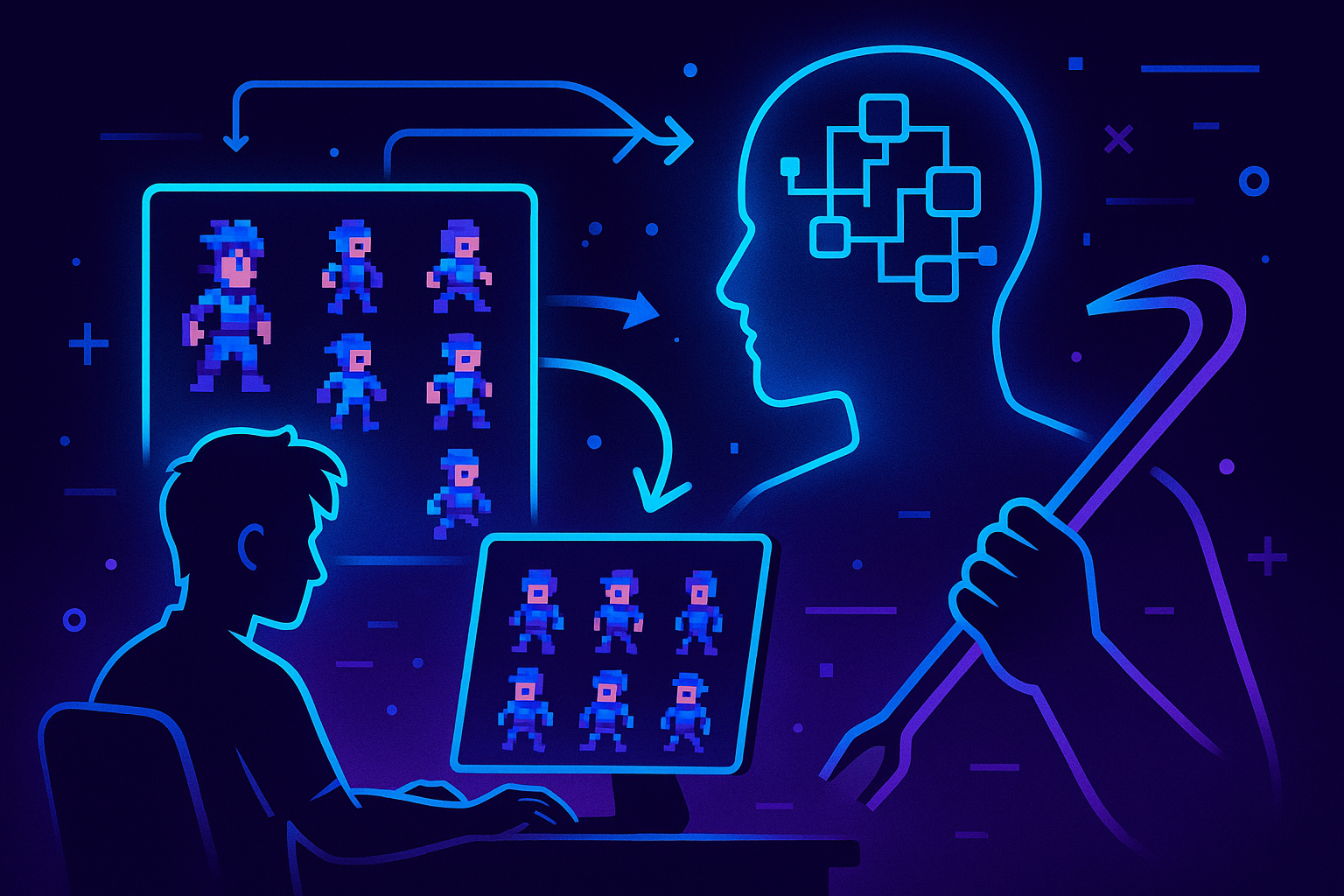
In 2025, that wall finally started coming down. AI sprite generators are the crowbar.
I've watched three separate indie teams this year cut their asset production timelines from months to afternoons. Not because they got better at drawing. Because they stopped drawing.
What actually changed in 2025
The shift isn't that AI can make sprites. It's that AI can now make usable sprites. Clean frames. Transparent backgrounds. Animation cycles that don't look like a seizure.
That last part matters more than people think. For years, generative tools spat out gorgeous single images that were completely useless the moment you needed a second frame to match the first. Consistency was the wall everything crashed into.
Tools like AutoSprites AI attack that specific problem. You describe a character, you get dozens of variants, you pick one, it animates. The frames line up. The background is already transparent. It exports as a ZIP that drops straight into Unity or Godot or whatever you're building in. No cleanup pass, no matte extraction, no praying the shadow color matches across frames.
How the pipeline used to look
Here's the old workflow. If you've done it you know I'm not exaggerating.
You'd sketch a character in Krita or Aseprite. You'd redraw it four to eight times for a walk cycle. Then again for idle, attack, hurt, death. Then you'd notice the palette drifted between frames and start over. Then a playtester would say the character should have a hat. You'd cry a little. You'd add the hat to twenty-seven frames by hand.
A single humanoid character with a reasonable animation set could eat two full weeks. That's if you already knew what you were doing. Beginners? Months, easily, and the result usually still looked amateurish.
How it looks now
You type a description. You get options. You animate. You export. That's the loop.
The interesting part isn't the speed, though the speed is genuinely absurd. It's what the speed enables. When making a new enemy takes ninety seconds instead of six days, you stop treating enemies as precious. You experiment. You try a version where the goblin has a wizard hat. You try five color palettes for the boss. You throw out the ones that don't feel right, instead of shipping them because you already sank forty hours in.
That's the real reshape. Not "faster art." Cheaper iteration. Iteration is where good games get made.
Where the competitors still fit
Now, I'm not going to pretend AI has flattened the whole toolkit.
Aseprite is still the best pixel editor on the planet if you want handcrafted, deliberate, single-artist work. Piskel is fine for quick browser mockups. Krita's a monster for painterly 2D. Spine and Dragon Bones do skeletal animation in a way generative tools don't really touch yet, especially for complex rigs. Lospec's palette work is still where a lot of stylists start, and GraphicsGale and GlueIT have their loyalists too.
None of these are going away. What's happening is more interesting. The AI tools handle the bulk. The traditional tools handle the polish. You generate 90% of your enemy roster with an AI game sprite generator, then you open the two hero characters in Aseprite and hand-tune them to hell and back. That combined pipeline is where most of the smart indies I know have landed.
What indies are actually building with this
A few concrete things I've seen this year:
- A two-person team shipped a demo with 60+ unique enemy sprites. Their previous game had 12. Same team, same six-month cycle.
- An educator running a game dev class had students prototype full playable builds in a weekend. Not "prototype scope" builds. Full ones, with title screens and boss fights.
- A studio prototyping a pitch made three fully art-styled vertical slices in the time it used to take to make one, picked the one that felt best, and the publisher signed it.
None of this was possible in 2022. Barely possible in 2024. In 2025, it's just how work gets done.
Marketing-side, the same pressure is showing up in adjacent tooling. Platforms like CreatorFetch (which help indies find creators to cover their games) are seeing more first-time devs actually reach that stage, because they finish. The art wall used to eat them before they got anywhere near a launch trailer.
The honest caveats
The tradeoffs exist. Pretending they don't is what makes most AI coverage feel like a sales pitch.
Style consistency across an entire game is still a discipline. Generate 200 sprites over three months without keeping tight prompt notes and they'll drift. The tools are getting better at this, but it's on you to curate. You still need taste. Taste is the only skill AI hasn't touched, and probably won't.
Also, hyper-specific art direction, the kind where you want every pixel deliberate, is still faster by hand for a talented artist. If you're building a love letter to Game Boy Advance chunky sprite work with a specific 4-color palette and dithering rules, you're going to fight the generator more than you'd like. Use the right tool.
Where this goes next
My honest guess: by the end of 2026, generating an animated sprite with clean frames and transparent output will be as standard as importing a font. The debate won't be "should we use AI for sprites." It'll be which model, which pipeline, and how you keep the style locked. Teams still hand-drawing every frame will be the exception, the way pixel-art purists are today. Respected, but niche.
If you're an indie sitting on a game idea and the art wall is what's stopping you, that wall is shorter than it was a year ago. Poke it. See what falls over. Try generating a few sprites and see if the workflow clicks for how you actually build.
The art bottleneck was real. It kept a lot of good games from existing. It's not the bottleneck anymore. That's going to show up in what indies ship over the next two years.
Written by the CreatorFetch.com editorial team.