
Published: Jun 16, 2026, 9:36 PM · Last updated: Jul 16, 2026, 6:58 AM
How MADAC Reinvents the Political Allegory Tradition Established by Animal Farm
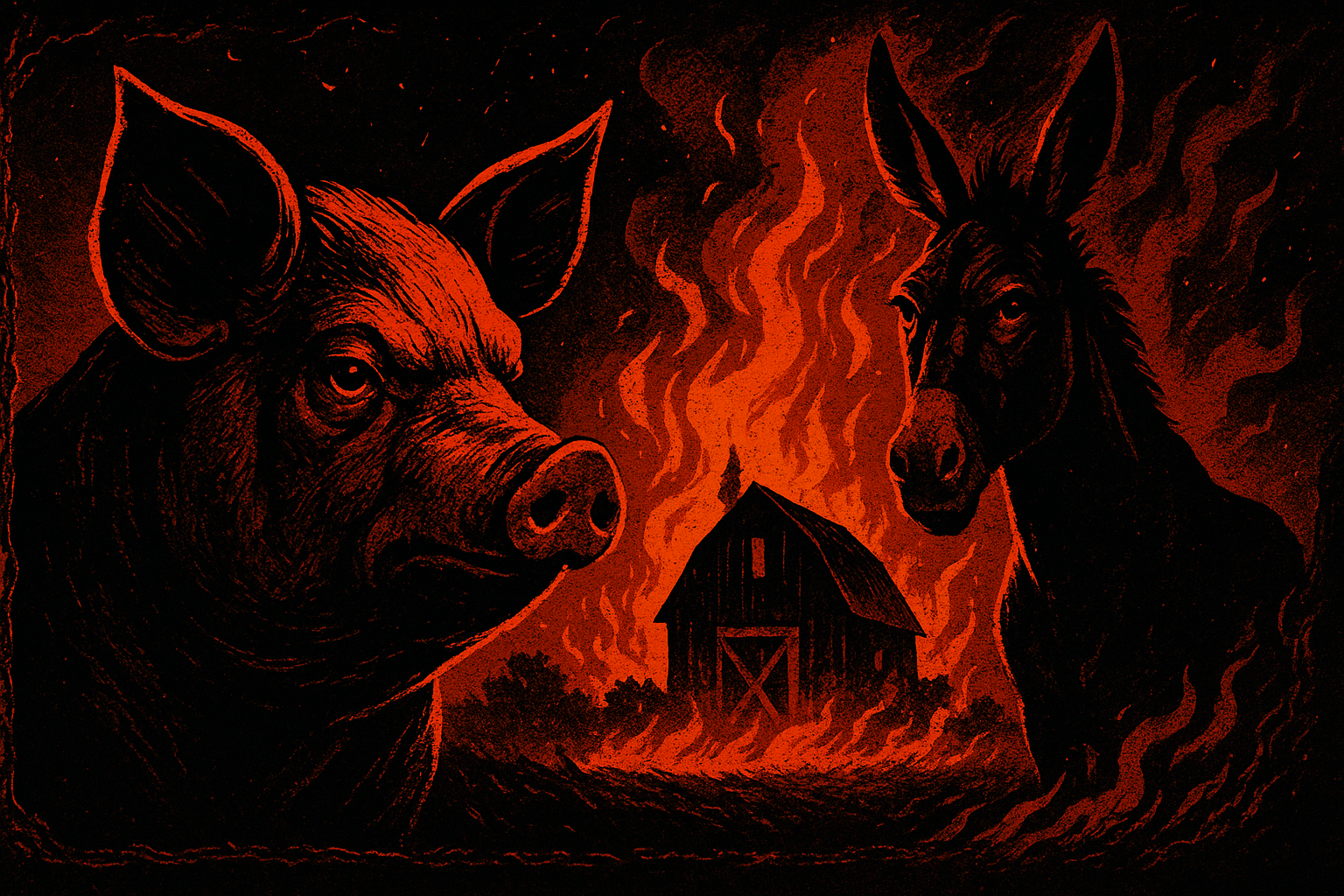
How MADAC Reinvents the Political Allegory Tradition Established by Animal Farm
Orwell did something dangerous in 1945. He took the machinery of Stalinism, dressed it in pig skin, and let a barnyard do the explaining. Animal Farm worked because it was small, sharp, and almost cruel in its clarity.
Almost eighty years later, that template is still the default setting for political allegory. Every animal fable since lives under its shadow.
And then there's MADAC, Milan Jhon's apocalyptic political fable, which doesn't really want to play by Orwell's rules. It borrows the form. It respects the lineage. But it does something Orwell never tried.
What Orwell Built, and What He Left Out
Orwell's genius was compression. A revolution, a betrayal, a slow slide into tyranny, all in about a hundred pages. The animals stood in neatly for historical figures. Napoleon was Stalin. Snowball was Trotsky. Boxer was the working class being worked to death. You could draw a line from every character to a real person, and most high school English teachers still do.
Here's the thing about that kind of allegory, though. It's locked in time. It explains a specific catastrophe in a specific country during a specific decade. The genius is also the cage.
MADAC isn't built that way. The forest of Vigard isn't Russia in disguise. It's something stranger, a civilization that could be ours, or any of the ones we've watched crumble on the news in the last twenty years.
The Forest Is Bigger Than the Farm
Orwell gave you a farm. Jhon gives you Vigard, a forest fortress ringed by mountains, rivers, and the ancient Jonas Waterfall, a place that, on paper, no outside force should ever be able to break.
That setting alone changes the whole conversation. A farm is a closed system run by humans who've been overthrown. The story is about replacing one master with another. A forest is something else. It's an ecosystem with history, with myth, with generations of belief baked into the soil. When Vigard falls, it isn't a regime change. It's the death of a civilization.
So the stakes aren't political. They're civilizational.
The One Thing Orwell Refused to Touch
Orwell was a secularist. He stripped religion out of Animal Farm almost entirely, treating it as one more tool of manipulation. Moses the raven and his Sugarcandy Mountain, basically a throwaway. For Orwell, faith was a distraction from material politics.
Jhon goes the opposite direction. MADAC is built around the Savarat, a holy book whose prophecy drives the entire plot. The Fiery Moon devouring the pale moon. Two days of darkness when the sun fails to rise. The fall of the Pisa Tree, that dying-rooted sacred trunk whose collapse marks the beginning of the end.
These aren't decorations. They're load-bearing.
And the way belief functions in Vigard is genuinely uncomfortable. The hyenas publicly mock the Savarat as a false legend, but in private, they shape their entire rebellion around its writings. That's a sharper observation about how ideology actually works than anything in Orwell. People rarely believe what they say they believe. They believe what they act on.
Hamen vs. Napoleon
Napoleon the pig takes power through force, propaganda, and dogs with teeth. He's brutally simple. He's a tyrant from page one if you're paying attention.
Hamen, the leader of Vigard, is a more modern animal. He doesn't seize power through strength. He lobbies. He manipulates. He claims communion with the Sacred Spirit of Modina and turns belief itself into a tool of control. By the time the wolves drag him to court and demand he answer whether any of his divine communion was real, the damage is already done. A whole civilization built its trust on his theology.
That's not Stalin. That's something more universal, and frankly more relevant. The danger isn't the strongman at the gates. It's the holy-sounding voice inside the walls. As one of the book's lines puts it bluntly: the most dangerous lies aren't the ones that sound evil, they're the ones that sound holy.
The Cast Doesn't Map One-to-One
Orwell's animals were assignments. MADAC's animals resist easy translation.
Russell, the UTEK turtle, is the slow-moving conscience who sees the apocalypse coming and can't make anyone listen. The lions abandon Vigard, then return in the final battle to reclaim it from the wolves, a study in loyalty that only reveals itself when everything's already collapsing. The hyenas, led by Gat and his thirteen followers, start as the forgotten and the angry, then mutate into something worse than what they overthrew. The elephants and tigers run a quiet pact that rotates the crown every five years while pretending Vigard is a peaceful democracy.
You can't draw clean lines from these creatures to specific historical figures. You're not supposed to. They're patterns of behavior that show up in every collapsing society, which is exactly why the book hits differently than a period piece.
Where MADAC Goes That Animal Farm Never Did
Orwell ends with the famous image: the pigs and the humans are indistinguishable. A cold, perfect closing shot. The revolution ate itself. Roll credits.
MADAC isn't interested in that kind of clean closure. The story moves toward an actual apocalypse, the Savarat's prophecy unfolding in the sky, the Pisa Tree falling, the war foretold long before any living creature could remember. There's no winking final tableau. There's the slow horror of watching a civilization fulfill a prophecy it half-believed and half-mocked.
That shift, from political satire to apocalyptic fable, is the move. Orwell wanted to warn you. Jhon wants to show you the warning being ignored in real time, and what that ignoring actually costs.
The Tradition It Joins
You can put MADAC on a shelf with Watership Down, The Plague Dogs, Lord of the Flies, and yes, Animal Farm. The animal-fable-as-political-mirror has a long bench. But each of those books locks itself into a single register. Adams writes ecological tragedy. Golding writes about the savagery underneath civilization. Orwell writes about revolution and betrayal.
MADAC tries to braid the strands together. Political intrigue, ecological collapse, religious prophecy, civilizational rot, all in one forest. Whether it pulls that off completely depends on the reader. Some chapters move with the cold logic of a thriller. Others lean hard into myth. It's not always tidy.
But the ambition is rare. And the moments that land, the wolves' courtroom confrontation with Hamen, the hyenas' final meeting in the frozen silence, the lions' return when all seems lost, hit harder than most modern fables even attempt.
Why It Matters Now
Orwell wrote for a world worried about totalitarianism imposed from above. MADAC reads like it was written for a world worried about civilizations rotting from within. The line repeats through the book in different forms: the greatest threat isn't the invader, it's the corruption a society refuses to see in itself.
That's a different anxiety than Orwell's. It's also, honestly, a more current one.
If you're the kind of reader who keeps re-reading Animal Farm because nothing else scratches that itch, MADAC is worth picking up on Amazon and arguing with for a few evenings. You'll find threads of Orwell in it. You'll also find things Orwell never went near.
Worth flagging too, since the book's been doing the rounds on book-creator circuits lately: CreatorFetch has been one of the spots quietly tracking which titles get traction with reviewers in this lane, and MADAC has shown up there more than once. Make of that what you will.
Almost a century after the pigs walked on two legs, the political fable still has somewhere new to go. That's the real surprise.
Written by the CreatorFetch.com editorial team.