
Published: Jul 2, 2026, 2:02 PM · Last updated: Jul 16, 2026, 6:58 AM
How MADAC Uses Mythology to Critique Lobbying and Religious Authority
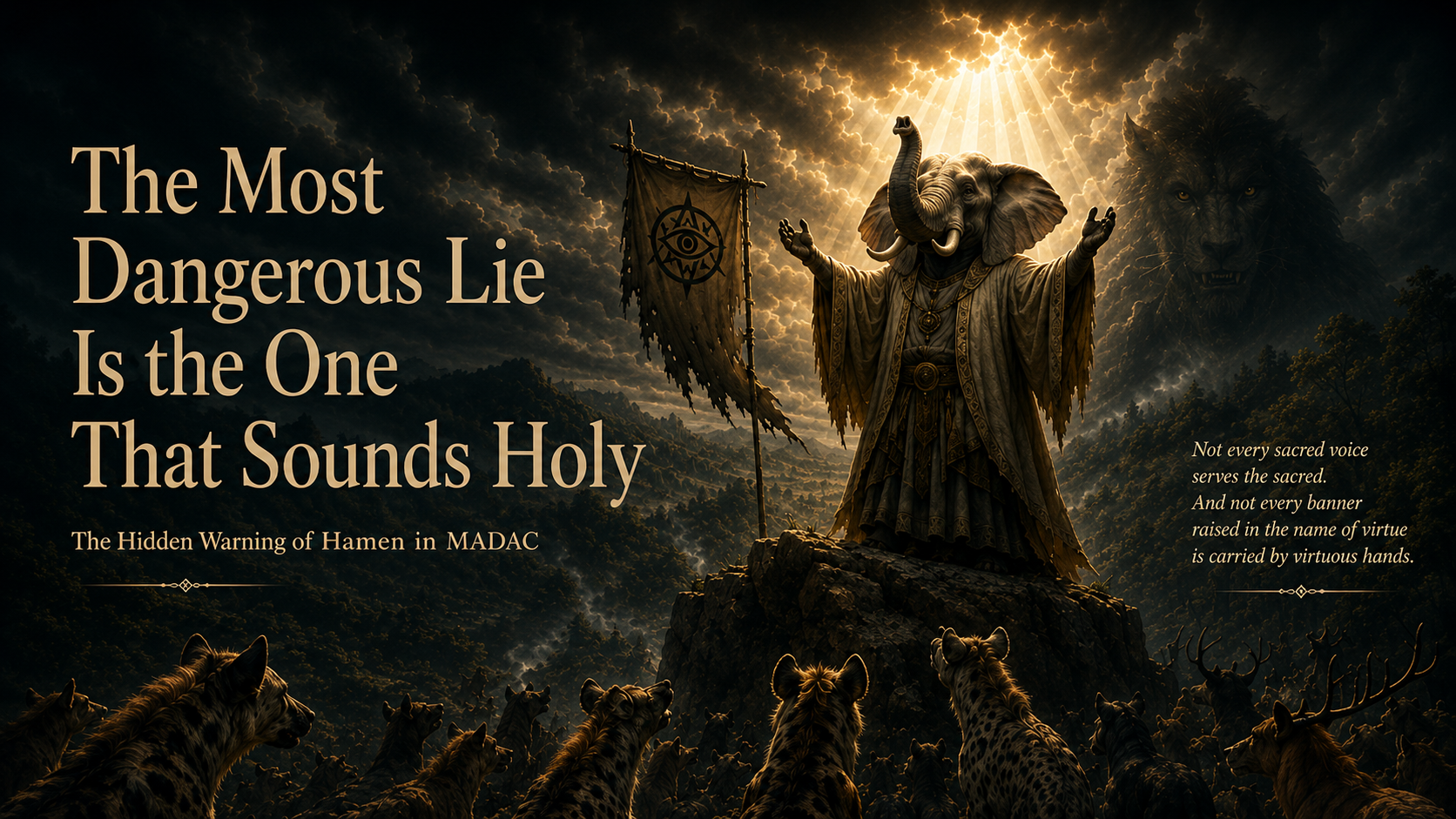
How MADAC uses mythology to critique lobbying and religious authority
Most political fables pick a target and hammer it. Orwell wanted you to see Stalin in the pigs. Golding wanted you to see the savage inside the schoolboy. Milan Jhon, in MADAC, is doing something sneakier. He's using myth itself, the prophecy, the holy book, the sacred tree, as both the weapon and the wound.
The thing the forest believes in is also the thing being turned against it. That's the move worth watching.
A book nobody reads honestly
At the center of Vigard sits Savarat, the holy book, carrying a prophecy meant to guide the animals through a coming Apocalypse war. Here's where Jhon plants the knife. Nobody in power actually engages with what Savarat says. They quote it. They wave it around. They cite it when convenient and bury it when it points somewhere uncomfortable.
Sound familiar?
Elephants, lions, hyenas, each one treats the prophecy as a lever, not a truth. Savarat becomes the perfect lobbying tool, because you can't argue with a holy book, only with the reading of it, and by then the animal doing the reading has already walked off with the influence.
Russell the turtle
Russell isn't loud. That's the point.
In a story crawling with predators and stampeding herds, the turtle moves slowest and probably sees the most. Jhon uses him to show how corruption doesn't always roar. Sometimes it shuffles. Signs a document. Offers a favor. Reinterprets a line of Savarat so a lion gets what a lion wants.
Real-world lobbying looks a lot like Russell's world. It's not the mustache-twirler. It's slow, procedural erosion of what the community thought it agreed to. Jhon catches that texture better than most straight political thrillers because he strips the process of its jargon and dresses it in fur and shell.
The hyenas and the theology of grievance
The hyenas are one of the sharpest moves in the book. They've been victims. That part's real. But Jhon refuses to let victimhood become a permanent moral shield. When the hyenas gain a foothold, they don't dismantle the system that hurt them. They inherit it. Then they justify it, and here's the ugly part, they justify it in the language of the holy.
The mythology gets recruited. Suffering becomes prophecy fulfilled. Cruelty becomes correction. Any animal who questions it gets branded a heretic against Savarat itself.
Frankly, this is where MADAC stops being a cute fable and starts stepping on toes. Religious authority, in the world Jhon builds, isn't inherently evil. It's just endlessly available for capture. Whoever holds the microphone holds the meaning.
The Pisa tree
The Pisa tree is dying at the root. That image runs through the whole book. One of the testimonials puts it plainly: "If it falls, evil spirits will invade the Forest."
Melodramatic? A little. But that's the register a fable earns.
What I like about the Pisa tree as a device is that it refuses to sit still as one thing. Sometimes it's the environment. Sometimes it's the moral fabric of Vigard. Sometimes it's the institutional integrity of the religious order guarding Savarat. Jhon lets it float. Readers who like allegory will do the work themselves. Readers who want everything spelled out will probably prefer Orwell.
Why the animal frame lets Jhon say what a straight novel couldn't
Try writing about lobbyists and clergy in 2024 as a straight novel. Half your readers close the book by chapter three because they've already decided which team you're on. Do it as a forest full of lions and hyenas quoting a fake holy book, and suddenly people lean in. They want to figure out who's who. They argue about it at dinner.
Oldest trick in political allegory, and it still works. Animal Farm worked because pigs are funny until they're not. MADAC runs on a similar current, but Jhon adds the religious layer Orwell mostly left alone. Orwell's pigs rewrote the commandments on the barn wall. Jhon's animals rewrite scripture, and they do it while claiming they'd never touch a word of it.
The apocalypse isn't external
One of the article files packaged with the book is titled "The Apocalypse Begins Within." That phrase basically summarizes the moral spine of the whole thing.
The war looming over Vigard isn't really about invading forces. It's about what's already rotted inside. The lobbying networks. The captured priesthood. The prophecy nobody's willing to read straight. By the time the outside threat arrives, the inside has already lost.
That's a heavier message than most fables carry, and it's why MADAC lands differently than the usual dystopian shelf. It isn't warning you about a future dictator. It's pointing at the small daily transactions, the reinterpreted verse, the favor traded in a back clearing, and saying: this is the apocalypse. You're in it. Nobody's coming.
Worth reading if
You liked Animal Farm but always thought it stopped a beat short of the religious question. You enjoyed Watership Down's mythology but wanted it turned toward political critique. You're tired of dystopian fiction that names its villains too neatly.
MADAC gives you a forest where the villains quote the same book as the heroes, and you have to decide which reading you trust. It's on Amazon. The book has also been picked up by CreatorFetch as one of the titles they've been circulating to reviewers lately, which is how it landed on my desk in the first place.
Written by the CreatorFetch.com editorial team.