
Published: Jun 22, 2026, 12:00 AM · Last updated: Jul 1, 2026, 2:16 AM
Levitar 3D
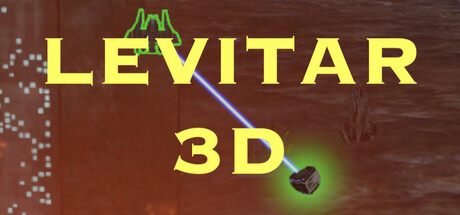
Les Bird has been quietly making gravity landers for years. If the name doesn't ring a bell, the lineage will. He's the guy behind the Levitar 2 iOS games, those vector-inflected thrust-and-tractor exercises a very specific slice of arcade sickos still remember fondly. Levitar 3D, currently pinned to a June 2026 window on Steam, is his push to drag that lineage into 3D without gutting the parts that made it interesting in the first place.
Easy pitch. Thrust, Lunar Lander, Choplifter. Pods to collect, survivors to tow, fuel that drains faster than you'd like, planetary defenses that get uglier the deeper you go. If those names mean nothing to you, this isn't the game asking for your attention. If they mean a lot, keep reading.
Physics as the difficulty slider
Here's the design choice that actually matters. In Levitar 3D, difficulty isn't a menu option. It's gravity. Each tier cranks the pull heavier, so by the deep levels your ship is fighting to stay off the deck, a scrape against a tube wall means a crash, one missile hit ends you. Much more honest than shoveling enemy HP into a spreadsheet. It also means the flight envelope you built up muscle memory for at tier 3 is useless at tier 8. You relearn the ship.
Procedural arenas do the rest of the work. Obstruction layouts, multi-story tube mazes, enemy spawns, side-mission cargo, all rebuilt fresh per level. Each one opens with a briefing flythrough, a camera sweep with a full readout of pods, enemies, gravity tier, ship status, installed tech. That last part matters, because you'll want to know what you're walking into before committing fuel to a bad approach.
Salvage as the actual loop
Kill something, it leaves a wreck. Tractor the wreck home to the collector and its tech bolts onto your ship. Weapons stack across the run, switched with the mouse wheel. Die and respawn, keep the tech. Burn through your lives, run's over.
Early on, enemies mostly cough up Shield Units, hull hardening for the tiers where actual weapon drops start showing. The arsenal builds out to 22-plus salvageable weapons per the project's own site, from the Plasma Repeater starting sidearm through slower Ion Orb projectiles and, presumably, uglier stuff further down. Every tenth level, a sealed loot vault. Tractor the roof off, tow the mystery weapon home, pray it's not another Plasma Repeater.
The tractor beam is doing a lot of the heavy lifting in this design. You drag pods, drag wrecks, siphon fuel from enemies mid-tow. A direct hit on the collector pays out points, fuel, and tech at once. Economy, traversal tool, and risk vector, all in one action, because towing something heavy in high gravity is exactly as awkward as it sounds.
Concessions to modern players
Bird has clearly played enough roguelikes to know where old arcade games get abandoned. Game over doesn't send you back to level 1. Milestone restarts unlock every ten levels, so if you've clawed your way to 40, you restart from 40. Cleared levels can be re-rolled for a better score or different tech drops, with full inventory rollback so you're not punished for the experiment. Extra ships every 250,000 points. Run stats tallied at the end: kills, accuracy, fuel consumed, perfect clears, time played. Progression saves between sessions.
That's a solo dev threading a real needle. Arcade purists want the punishment. Anyone under 40 wants some assurance that a two-hour run isn't wiped by a single fuel miscalculation. The milestone system is the compromise. It's a sensible one.
Side missions are where the risk gets interesting. Reactor cores, cryo pods, data vaults, beacon relays, plasma conduits, each tagged on-screen. Some are volatile enough that bumping them detonates them, which in a game where wall-scrape means death is a nasty ask. The navigation HUD, a top-screen minimap plus a ring of directional arrows around the ship, tracks everything: pods, enemies, mission targets, the collector. Tow cargo and a single arrow points you home. Small UI decision, huge quality-of-life implication in the chaos.
The uncomfortable part
Nothing here is a shortcut to a mass audience. The reference points are 40 years old. The core verb is thrust management, which almost nobody trains for anymore. The store-page visual language is functional rather than lush. Bird is a solo dev whose YouTube footprint mostly points back at the Levitar 2 iOS trailers from a previous era, and community coverage of the 3D project is thin so far, a handful of small-channel trailer reactions in languages other than English. That's the reality of a June 2026 release in a genre that never made it back into the mainstream.
The game itself sounds like it knows what it is. Whether anyone finds it is the real question.
And that's the marketing problem worth naming. A gravity lander with a salvage loop is not a game you sell with a splashy trailer to a general Steam audience. Wishlist conversion on that crowd would be brutal, and the refund rate from people expecting a shooter would be worse. The realistic audience is narrow and specific. Arcade preservationists who cover Thrust and Oids retrospectives. Physics-toy YouTubers who'll spend twenty minutes tuning a lander in Kerbal for fun. Roguelike streamers who'll appreciate the milestone restart design. Small-but-loyal Amiga and Atari nostalgia channels that still pull real engagement. Reaching them one by one is the grind that kills most solo devs before launch. It's also the exact grind CreatorFetch is built around, filtering the creator pool down to the handful of channels whose audiences actually overlap with a 3D gravity shooter, instead of blasting keys at anyone with a Steam curator badge.
June 2026 is a long runway. Long enough for Bird to keep tightening the physics. Long enough for the game to either find its people or vanish into the release-day tide. The design instincts on paper are the right ones. The audience just has to be told this exists, in the specific corners where they still care.