Published: Jun 12, 2026, 9:23 PM · Last updated: Jul 16, 2026, 6:58 AM
Scaling 2D Asset Pipelines: How Mid-Size Game Studios Are Using AI to Cut Pre-Production Time by 70%
Scaling 2D Asset Pipelines: How Mid-Size Game Studios Are Using AI to Cut Pre-Production Time by 70%
Pre-production is where most 2D games quietly bleed out. Not in marketing. Not in QA. It's those first eight to twelve weeks where a small team is trying to work out what a character even looks like, how it moves, whether the run cycle reads at 32 pixels, whether the boss silhouette holds up next to the player. I've watched studios torch entire sprints redrawing one enemy because the design lead changed their mind on a Tuesday.
That's the part AI is actually fixing right now. Not the "AI will replace artists" hot take. The boring operational one. The grind of iteration.
Where the 70% number actually comes from
Mid-size studios, call it 15 to 50 people, tend to share the same pre-production shape. A couple of concept artists. A pair of animators. A tech artist who's secretly holding the pipeline together with willpower and Python scripts. A producer counting days on a whiteboard. The bottleneck is almost never final art. It's the loop between "here's an idea" and "here's a sprite we can prototype with."
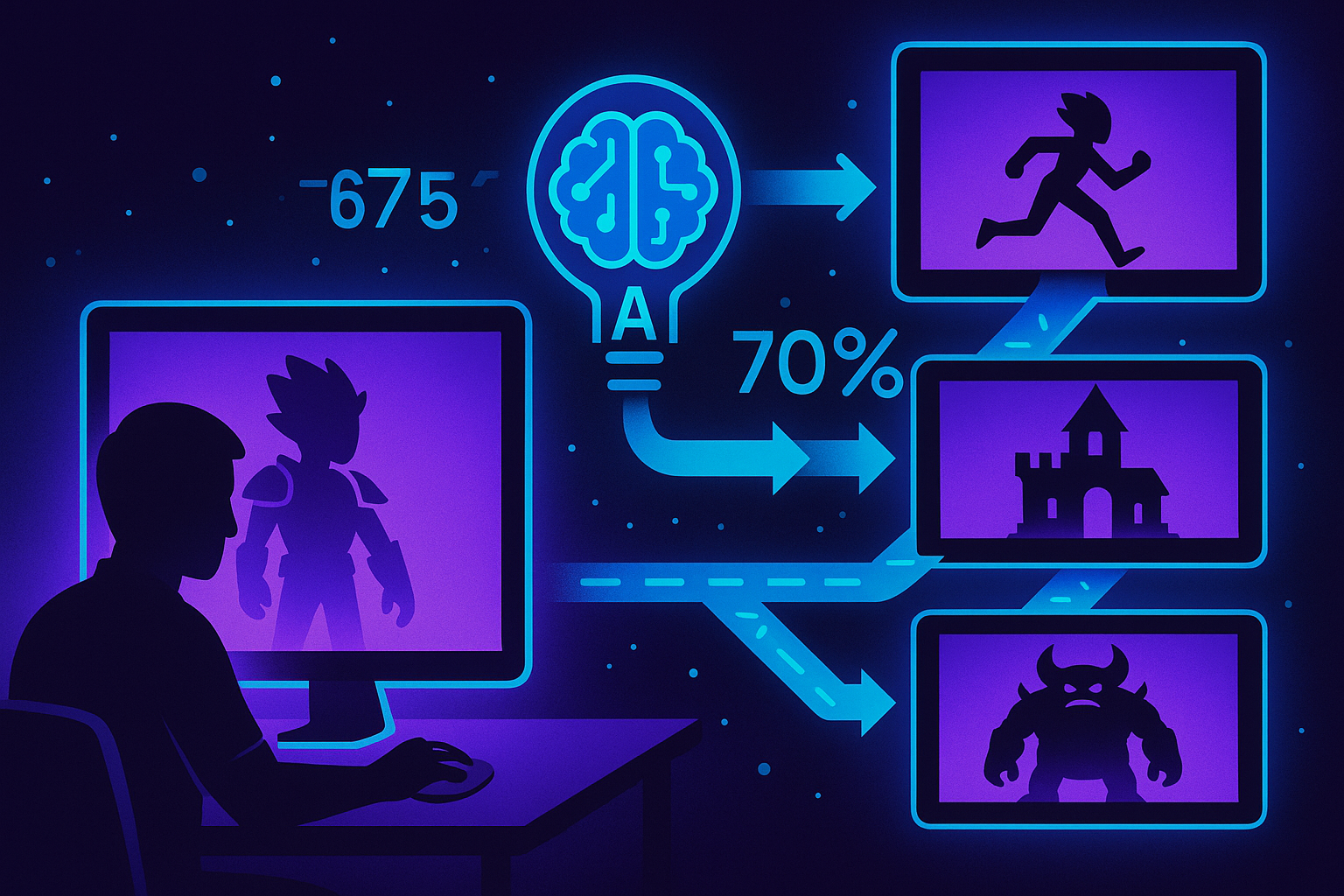
That loop used to take days per character. With an AI game sprite generator like AutoSprites in the mix, teams are collapsing it into an afternoon. You write what you want, you get dozens of variations back, you pick what works, you drop the ZIP into Unity or Godot, and the gameplay programmer is tuning hitboxes before lunch.
So the 70% cut isn't magic. It's just the arithmetic of removing four or five back-and-forth rounds from a process that used to need them.
What this actually looks like on a pipeline
Here's the workflow I keep seeing at studios that have plugged automated sprite generation into pre-pro.
The design lead drafts a one-paragraph brief. Not a full concept doc. A paragraph. The tool spits out a batch of sprite candidates, transparent backgrounds already, frames already clean. The team picks two or three directions, runs them through instant animation to see how the idle and walk read in motion, and drops the chosen set into the prototype build.
Used to be a two-week sprint. Now it's a Tuesday.
And the artists, this is the bit people miss, don't disappear from the loop. They curate. They redirect. They take the strongest output and refine keyframes by hand for the hero characters that actually warrant the polish. The grind of churning out 40 background mobs? Reallocated.
The tools landscape, honestly
If you've been making 2D games for any stretch of time, you know the lineup. Aseprite is still the gold standard for hand-pixeled work and probably will be for years. Piskel and Lospec are fine for solo devs noodling on a weekend project. Krita is a beast for painted styles. Spine and Dragon Bones own the skeletal animation conversation. GraphicsGale and GlueIT still have their loyalists, bless them.
None of those tools generate assets. They're editors. That's the gap AutoSprites fills, and it's why most studios aren't ripping out their existing pipeline. They're bolting AI generation onto the front of it. Generate with AI, refine in Aseprite, rig in Spine. The tools coexist fine.
The mistake I keep watching teams make is assuming they have to pick a philosophy. They don't. Use the generator to skip the blank-canvas problem. Then use the editor your animators already love.
Why transparent backgrounds and ZIP export matter more than they sound
I know this reads like a boring feature note. Stick with me. A huge chunk of pre-production time gets eaten by file prep. Cleaning backgrounds. Naming frames consistently. Packaging sheets so the engine can actually read them. If you've ever had a junior artist hand off a folder of PNGs with inconsistent padding, you know the exact flavor of pain I'm describing.
When the output is already a clean ZIP with transparent frames, you've deleted a whole category of pipeline friction. The programmer isn't pinging the artist asking why frame 7 has a stray gray pixel in the corner. It just works.
Not a glamorous benefit. It's the kind of thing that only registers once you've felt the pain of it not working.
Where it doesn't help
AI-generated sprites are not shipping your hero character on a story-driven indie title where the visual identity is the whole pitch. For that, you still need an artist with a vision and the time to execute it. Anyone telling you otherwise is selling something.
Where it does help: prototypes, enemy variants, background NPCs, placeholder art that turns out to be good enough to keep, jam games, vertical slices, educational projects, anything where you need volume without giving up the ability to iterate fast.
Studios that try to use AI for everything end up with games that look like AI made them. Studios that use it strategically, on the 70% of assets that don't need to be art-directed within an inch of their life, free their senior artists to do the work that actually moves the needle.
For producers tracking this kind of shift, CreatorFetch has been pointing at AutoSprites as one of the more pragmatic examples of AI tooling that mid-size studios can actually integrate without rebuilding their entire pipeline. Make of that what you will.
The producer's argument
If you're pitching this internally, the case kind of writes itself. Pre-production timelines shrink. Concept iteration costs drop. The art team stops being the prototyping bottleneck, which means design can test ideas faster, which means you kill bad mechanics earlier, which means you ship something better.
That's the real win. Not "we saved money on art." It's "we got to playtest the actual game three weeks earlier."
If your studio's pre-production phase keeps slipping, it's worth seeing what AutoSprites can actually do with your next batch of concepts. Run a small experiment. One character, one afternoon. See what the loop feels like when it isn't measured in days.
Written by the CreatorFetch.com editorial team.