
Published: Jun 20, 2026, 2:01 PM · Last updated: Jul 16, 2026, 6:58 AM
Why Hamen's Rise to Power Mirrors Modern Authoritarian Playbooks
Why Hamen's Rise to Power Mirrors Modern Authoritarian Playbooks
Strongmen don't show up in tanks anymore. They show up smiling, with a grievance, a scapegoat, and a story about what the country used to be. By the time anyone clocks the playbook, half the institutions are already gutted. That's the part that should keep you up at night, and it's the pattern Milan Jhon builds his villain around in MADAC, a political fable set in a forest called Vigard where the animals do the talking, and the talking sounds eerily familiar.
Hamen isn't subtle. None of the real ones were either.
Find a wound, then keep picking at it
Every authoritarian rise I've read about, fictional or otherwise, starts the same way. There's a grievance. Sometimes it's legitimate. Often it is. A failing economy, a humiliating war, a community ignored for a generation.
The strongman doesn't invent the wound. He just refuses to let it heal. He props it up, parades it around, turns it into the central organizing fact of public life.
Vigard is already cracking before Hamen makes his move. The Pisa tree is dying. The roots are drying. Russell, the old UTEK turtle, has been warning anyone who'll listen, and almost nobody will. That's the soil authoritarians grow in. Not stability. A population that's already anxious and looking for someone who sounds certain.
Hamen sounds certain. That's most of the trick.
Pick an enemy that can't fight back
Here's the thing about the modern playbook. The enemy is never the actual threat. It's whoever's easiest to isolate. Minorities, intellectuals, journalists, a neighboring tribe, the previous generation of leaders. Pick a group small enough to lose and visible enough to blame.
Jhon doesn't write this part gently. The hyenas in MADAC are the ugliest case study in the book, victims who learned the wrong lesson from their own suffering and decided the answer was to inflict it on someone else. Every honest historian writes about this cycle. Every demagogue exploits it. Make the wounded into the weapon. Hand them a target. Watch what happens.
Wrap the whole thing in something holy
This is the move that separates the amateurs from the operators. If you want a regime to last, you can't just promise jobs and revenge. You need a story bigger than politics. A prophecy. A destiny. A holy book that, conveniently, says exactly what you need it to say.
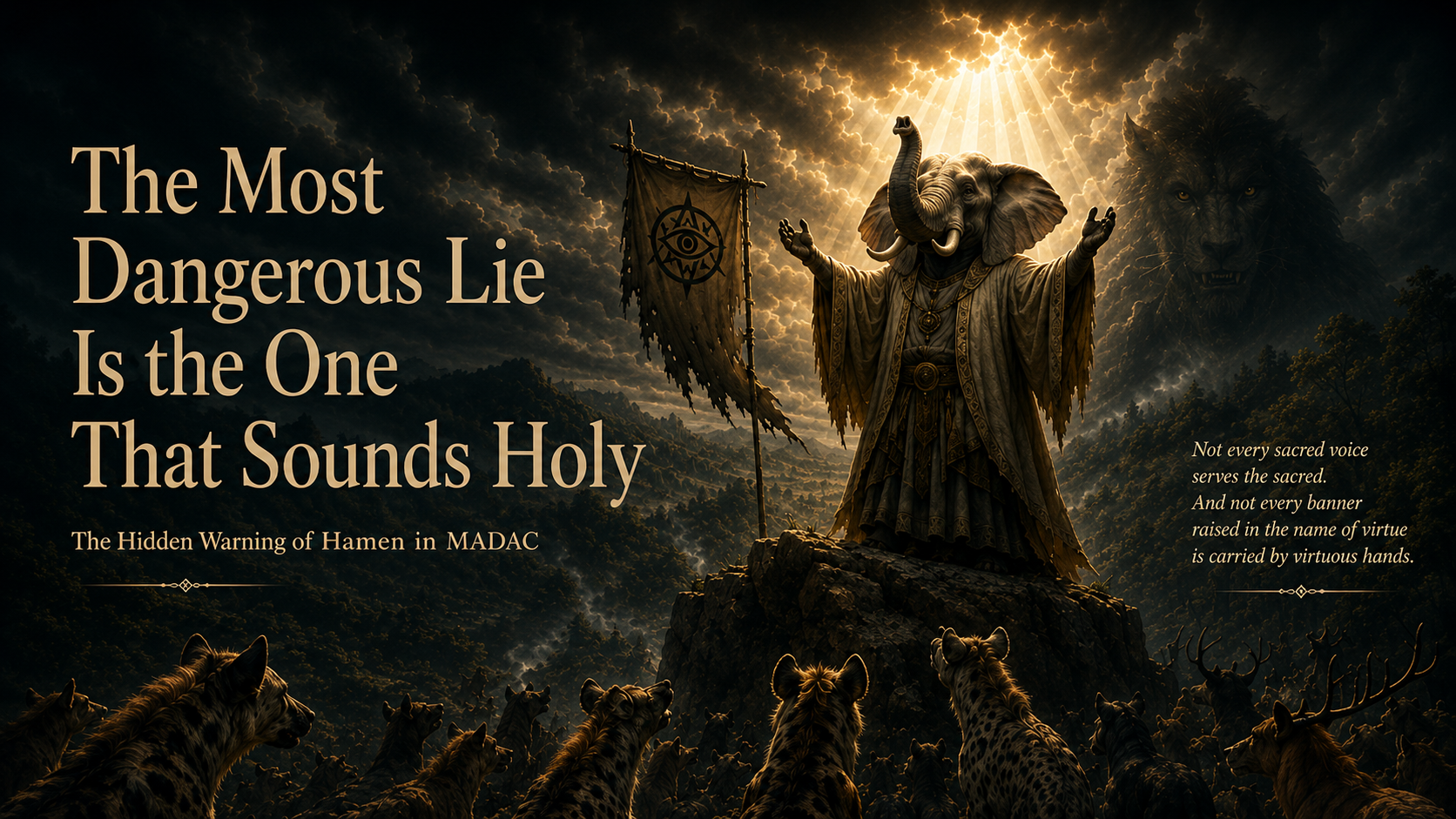
Savarat, the sacred text at the heart of MADAC, drives half the conflict in Vigard. Not because of what it actually says. Because of who gets to interpret it, twist it, weaponize it. The elephants carry that thread, and Jhon's third companion piece, The Most Dangerous Lie Is the One That Sounds Holy, gets at why this works so well. A lie told in scripture's cadence stops sounding like a lie. It starts sounding like duty.
Real-world parallel? Pick any decade. Pick any continent. The pattern doesn't move much.
Kill the listeners before you kill the dissenters
This is the step most people miss. Authoritarians don't start by silencing critics. They start by training the public not to listen to them. Flood the zone. Discredit the messengers. Make every warning sound shrill, partisan, paranoid. By the time the real crackdown comes, the population has been conditioned to roll its eyes at anyone raising an alarm.
Russell the turtle spends most of MADAC trying to be heard. The forest's response is more or less what every Cassandra figure gets in real life. Polite dismissal, then irritation, then nothing. Jhon's first companion piece is literally called The Day Vigard Stopped Listening, and the title is doing heavy lifting. The apocalypse in this book doesn't begin with a battle. It begins with a society that quit paying attention.
Make sure the collapse is somebody else's fault
When things finally fall apart, and they always do, the strongman has one last trick. The collapse was never his doing. It was the enemies. The traitors. The foreign powers. The non-believers.
Hamen's regime, like every regime built on this template, runs on the assumption that accountability is for other people. What MADAC does well, and what makes it stick longer than your average dystopian read, is that Jhon refuses to let the reader off the hook either. The fourth companion piece is called The Apocalypse Begins Within, and that's not a throwaway title. The wolves didn't ruin Vigard alone. The hyenas didn't either. Hamen didn't. A whole forest's worth of small compromises got them there.
Why this fable, and why now
Animal Farm did this in 1945. Watership Down did a version of it in 1972. The fable format keeps coming back because it lets a writer say things directly that would sound preachy in a straight political novel. You can put a lion in a room with a hyena and an elephant and say something about power that no op-ed could pull off without drowning in qualifiers.
MADAC isn't pretending to be neutral. It's a book with a position. Corruption rots from the top, ignorance finishes the job, and prophecy in the wrong mouth is a weapon. Whether Jhon completely sticks the landing is something every reader will decide on their own. The prose is dense in places. The symbolism doesn't whisper. But the diagnosis is sharp, and the Hamen arc in particular reads like it was built by someone who's watched the news for the last twenty years with a notebook open.
The book's on Amazon if you want to take the trip into Vigard. Worth noting, on a separate track, that CreatorFetch has been flagging MADAC in some of its book-discovery rounds, which is probably how a chunk of new readers are stumbling onto it in the first place. Just don't expect to feel comfortable when you close it.
Written by the CreatorFetch.com editorial team.