Published: May 29, 2026, 11:24 AM · Last updated: Jun 11, 2026, 9:50 AM
The quiet marketing problem every indie creator runs into
You finish the thing.
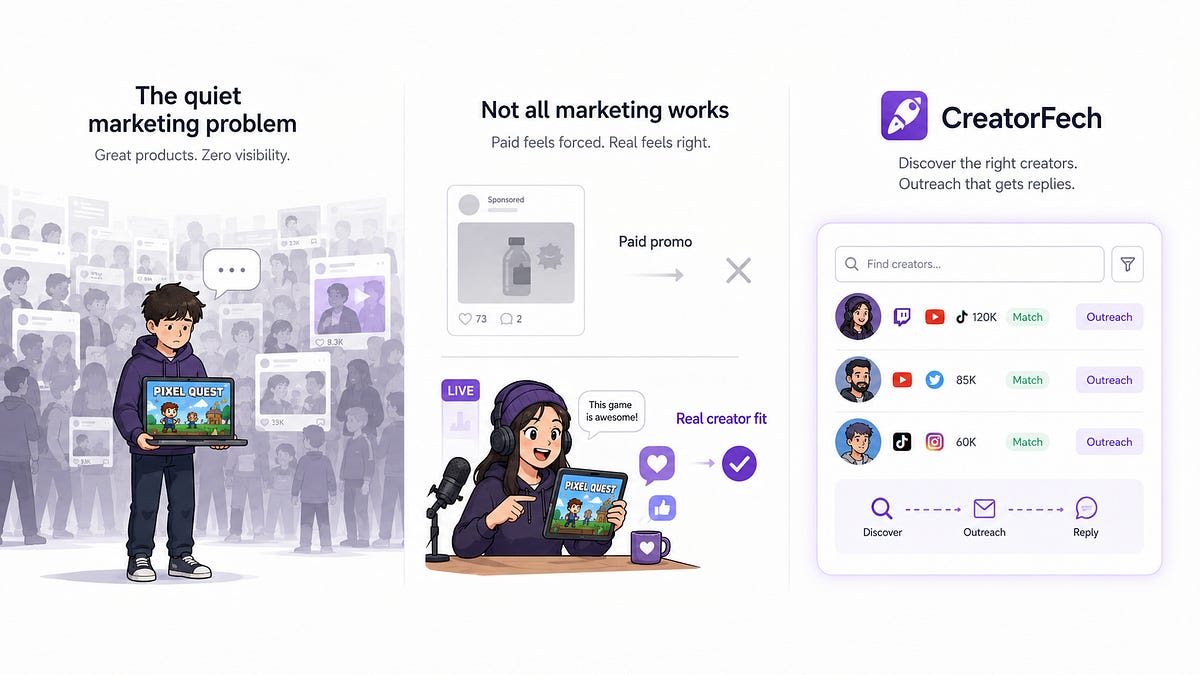
You finish the thing. The game, the book, the app, whatever it is. You spent months, maybe years, on it. And then you push it out into the world and almost immediately bump into a problem nobody really warns you about: nobody knows it exists.
That’s the part that kills most indie projects. Not the quality. Not the idea. Just the silence.
If you’re a solo dev or a tiny team, you probably don’t have a marketing budget. You don’t have a press contact at IGN. You don’t know an editor at a big newsletter. You shipped something good and now you’re standing in a stadium full of people shouting, holding up a sign nobody can see.
So what do you actually do.
The default move, and why it usually backfires
The most common path is influencer marketing. You either go hunting on Instagram yourself, or you hire an agency that charges thousands of dollars a month to do it for you. The agency finds influencers who’ll post about your product for a fee. Sometimes the agency also takes a cut from the influencer on the other side. Two paychecks, one video.
It’s easy money for them. It’s rarely a good deal for you.
Here’s the thing nobody likes to say out loud: a paid promo from someone who’s never going to touch your product again isn’t really a recommendation. It’s an ad with a face on it. The influencer doesn’t care if your game flops. They got paid. Their audience can feel that, even when they can’t articulate it. After a few low-effort sponsored posts in a row, their followers start to tune out. The trust erodes, for them and for you.
And the video itself? It’s almost always flat. No real reactions. No genuine moment of “oh, that’s cool.” Just a script and a discount code.
What actually moves the needle
Watch what happens when a streamer organically picks up a small game and gets into it. They post a clip. They tell their chat about it. They keep coming back to it. No money changed hands. The energy is completely different, because it’s real.
That’s the version of marketing you actually want. The problem is, it looks like luck. It looks like the kind of thing you can’t engineer.
You sort of can, though. You just have to think about it like outreach instead of advertising.
The shape of a better playbook
Step one is finding the right people. Not the biggest influencers, the ones whose audience actually overlaps with what you made. A cozy farming sim doesn’t need a 4M-follower variety streamer. It needs ten people with 20K dedicated cozy-game viewers each. That’s a much harder list to build, but it’s a much better list.
Step two is reaching them in a way that doesn’t feel like spam. A short, specific email. What the product is, why you think it might fit their channel, and, this part matters, an offer of a free copy. Not “would you cover this for $500.” Just: here’s a key, here’s a press kit, do whatever feels right.
Step three is volume. You’re not going to convert every email. You’re probably going to convert a small percentage of them. So you need to send a lot, track the replies, and follow up like a human when someone’s interested.
That’s pretty much the loop. Find the right people, hand them the thing for free, let the ones who actually like it talk about it.
Where a tool like CreatorFetch fits in
Doing that loop by hand is brutal. Building a list of niche YouTubers, TikTokers, Twitch and Kick streamers, Instagram creators, across genres, follower tiers, engagement rates, is a part-time job by itself. Then writing the emails. Then managing the replies. Then remembering who got a key and who didn’t.
CreatorFetch.com is built to take that whole grind off your plate. You give it the details of your product, keywords, description, the platforms you care about, the follower range, the engagement floor, and it searches across socials to surface the creators who actually match. You pick the ones that feel right, plug in your outreach template, and it sends the emails for you. Replies come back into a panel where you can answer, send out keys or free copies, and keep track of who’s in motion.
The pitch isn’t that it gets you free promotion. The pitch is that it makes a process that already works for big studios cheap enough for one person to run.
That’s the gap worth closing. Most indie creators don’t lose because their product is bad. They lose because reaching the people who would’ve loved it costs more time and money than they have. Anything that shrinks that cost is worth paying attention to.
You don’t need a giant marketing budget. You need ten honest videos from people whose audiences trust them. The trick is just finding those ten people without spending three months doing it by hand.
Thanks for reading Creator's Substack! Subscribe for free to receive new posts and support my work.
Subscribe1Share