
100 Sherwood Cats
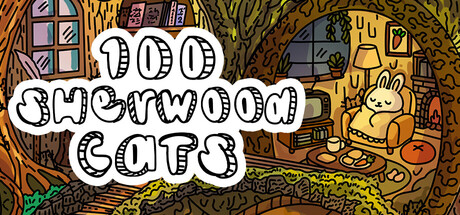
100 Sherwood Cats and the quiet, weird Steam economy nobody writes about
There's a corner of Steam most people scroll past without registering — the one where dozens of nearly identical hidden-object games sit side by side, each promising hand-drawn art and a stack of cats, dogs, frogs, or rabbits to find. 100 Sherwood Cats, from a studio literally called 100 Cozy Games, Cats, is the next entry in a series that's been stamping out releases at a pace most indie devs would find terrifying.
June 2026, on Steam. One level. A hundred cats. No text.
Honestly? I don't think it needs to be more than that.
What's in the box
Strip the emoji off the feature list and you get a checklist of what this micro-genre has standardized over the last three years or so: hand-drawn art at high resolution, zoom, a combo counter, hints, brightness adjustment, save progress, a soundtrack, and — the detail that actually made me smile — "real meow sounds." Not synthesized. Actual recorded meows when you tap the right pixel. That's the kind of small flourish that separates a five-minute asset flip from something an actual human shipped.
Sherwood theme means Robin Hood scenery, presumably. Forests, archery butts, maybe a tavern. Cats instead of merry men. The studio doesn't elaborate and that's fine — the whole genre runs on visual surprise. Telling you what's in the painting defeats the painting.
The assembly line
Here's the thing worth understanding about this developer. 100 Cozy Games, Cats sits inside a small cluster of studios — you'll find similar operations behind 100 Hidden Frogs, 100 Hidden Cats, and a stack of seasonal variants — that have quietly figured out the economics of low-friction Steam releases. Build one solid engine for hidden-object scenes, commission new artwork every few weeks, ship, repeat.
Not glamorous. Also not a scam.
The games tend to do exactly what they say. They sit at 95%+ positive reviews because expectations are perfectly calibrated, and they've built a quiet ecosystem of completionists who collect them the way some people collect cheap Switch eShop puzzles. No campaign, no narrative arc, no DLC roadmap. You buy one, you spend an evening finding cats, you move on.
At the prices these things usually launch at, that's a fair trade. The risk is the obvious one — any single entry blurs into the next. Sherwood is a smart pick because it gives the artists something genuinely distinct to draw. Green canopy light, longbows, period architecture. Not another generic café or holiday scene.
Under the hood (such as it is)
Don't expect anything wild. Single-scene hidden-object games run on practically any hardware shipped in the last decade — integrated graphics, a laptop your grandmother uses for email, a Steam Deck on its lowest power profile, all fine. The interesting technical question isn't performance. It's how the artwork is delivered. High-res canvases at the scale these games use can push individual scene files into the hundreds of megabytes, and zoom implementation matters more than people give it credit for. Bad zoom turns the whole experience into a smeary mess. A good one — proper mipmaps, clean asset pipeline — keeps the line art crisp even when you're squinting at a single thatched roof.
No public dev docs exist for this series, so most of this is inference from prior entries. The studio doesn't appear to maintain a site beyond Steam, which itself tells you where their marketing energy goes. Answer: nowhere visible.
The discoverability problem is funnier than you'd guess
Search YouTube for content about this series and the results are almost comically off-target. Slot machine streams. Viral animal clips. Cliff-jumping reels. The "cats" tag is so heavily contested by the rest of the internet that small hidden-object games get buried under an ocean of unrelated feline content. There's no meaningful creator footprint for the 100 Cats series specifically, and the studio has clearly been living with that problem for a while.
That's not a knock on the games. It's a structural issue when your title competes with every cat video ever uploaded.
The marketing math
A game like 100 Sherwood Cats will never win a mass-market campaign. The math doesn't work. You can't buy ads against "cozy hidden object" and expect a return — the audience is too small, too price-sensitive, scattered across regions and languages. The "no text" design is itself a quiet acknowledgment of that last point; the game ships globally to non-English speakers with zero localization overhead.
What does work is reaching the handful of creators who actually serve this niche. The cozy-games YouTubers who do sub-hour playthroughs of low-stakes puzzle titles. Streamers running "find the thing" games as chill background content between bigger sessions. TikTok accounts that compile satisfying hidden-object zoom clips. The small Polish, Brazilian, and Japanese cozy-content channels where this genre has real traction.
Trying to find those people manually, one at a time, across regions — that's where small studios drown. It's the exact gap a tool like CreatorFetch is pitched at: letting a one-artist-and-a-coder operation actually identify the creators who already cover this micro-genre, instead of shouting into the Steam new-releases firehose. Whether that closes the gap or not is its own question.
Should you care?
If you already know whether you like this genre, you know the answer.
The 100 Cats series has earned a small, loyal following by being honest about what it is: a quiet hour, a nice piece of art, a hundred little dopamine hits as you tap each cat into existence. Sherwood is a stronger thematic hook than most of the entries before it, and if the artwork delivers on the Robin Hood promise, it could end up one of the better-looking ones in the catalog.
It's not going to change anyone's mind about hidden-object games. It's not trying to. And there's something to be said, in 2026, for a studio that ships exactly what it advertised on the tin.