A Lost Man
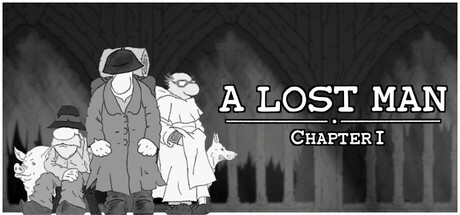
1916, a deserter, and a sketchbook full of mud
Studio Arkos is doing something stubborn with A Lost Man. A point and click adventure, drawn by hand on actual paper, set in the worst year of the Great War. No pixel-art nostalgia bait. No roguelite hook. No cozy farming layer bolted on for the algorithm. Just ink, ambiguity, and a soldier running from the trenches into something arguably worse.
Out June 25, 2026, on Steam. It's the kind of project that either finds its people exactly, or disappears inside a week of the release calendar.
What it actually is
You play a French soldier who deserts in the dead of night, somewhere between two front lines. You wander. You meet people who may or may not be hallucinations. You pick up objects, combine them, read documents, talk to strange characters, chew on puzzles. Classic LucasArts-era verbs, classic Sierra-era dread, routed through a very European, very paper-textured visual sensibility that owes more to wartime illustration than to anything in the modern indie scene.
The technical notes Arkos buries at the bottom of the Steam page are worth reading carefully. The game is authored natively at 2560x1440, with proper 3440x1440 ultrawide support, and the studio says it scales out from there. Small detail, big consequence for hand-drawn 2D, where naive upscaling turns crisp ink into mush. Designing at 2K first and accommodating other panels from that master, instead of upscaling a 1080p one, is the right call. Most small studios skip it because it roughly doubles the asset workload.
Originally written in French. Translated to English, and the studio is careful to use the word "faithfully," which in adventure-game land is code for "we did not let a localization mill butcher the tone." Good. With a script leaning on ambiguity and mysticism, the gap between a literal translation and a faithful one is the gap between a serious work and an unintentional comedy.
The aesthetic gamble
"Hand-drawn on paper" gets thrown around loosely. Cuphead is hand-drawn. Hollow Knight is digitally illustrated. What Arkos appears to be doing, judging by the imagery on the Steam listing, is closer to the first: real pencil and ink on physical sheets, scanned and assembled. That pipeline is brutal. Every animation frame is a piece of paper somebody drew, scanned, cleaned, stitched. It caps your scope hard. It also gives you a texture nothing else on the storefront has.
For a war story set in 1916, the materiality reads as intentional. The Great War was a war of letters, sketchbooks, field journals, official documents. A game that wants you to consult various documents while you piece together what's happening to this man, on paper that looks like paper, is doing something coherent rather than just stylish.
The community signal so far
The demo has been circulating with adventure-game YouTubers and a handful of Spanish-language gameplay channels, and the recurring note from creators trying it is that they haven't quite played anything like it. Some of that is real. The war setting plus mystical surges is not a crowded niche. Some of it is the natural reaction to a presentation that doesn't look like 90% of the Steam Next Fest queue. The video coverage skews toward demo walkthroughs and first-impressions deciphering the puzzle logic, not speedruns or theorycrafting, which is exactly the footprint a slow, atmospheric point and click should be building a year out from release.
What's missing from the public conversation: anything substantive about length, the puzzle difficulty curve, or how the "bursts of violence" actually play out inside a point and click structure. Those are the unknowns that decide whether this lands as a cult favorite or a respected curiosity.
Where the skepticism sits
Point and click has a brutal failure mode. Puzzles the designer found elegant and the player found insulting. The Steam copy promises puzzles that will "put your mind to the test," a line that can mean anything from Machinarium-clean to Gabriel Knight 3 cat-mustache. There's no track record to lean on. Studio Arkos doesn't have a back catalog that telegraphs the answer. The art and tone could carry a forgettable puzzle layer. They probably can't carry a hostile one.
Pacing is the other one. Desolate countryside, ghostly landscapes, ambiguous characters, that's a vibe that needs density. Spread it across too many screens and the dread turns into tedium. Arkos hasn't shown enough yet to know which side of that line they're on.
The marketing reality
A hand-drawn French point and click about a WWI deserter is not a game that survives a generalist marketing push. Throw it at the broad gaming audience that buys whatever Steam's algorithm surfaces and you'll burn money for nothing. The people who scroll past will keep scrolling. The people who'd actually love it will never see the trailer.
The realistic path is narrow and deep. Adventure-game YouTubers in the Adventure Gamers and ScummVM orbit. Narrative-focused streamers who covered Mundaun and Pentiment. French-language creators with audiences that already care about the historical material. Illustration and art-process channels who'd respond to the on-paper workflow. And the small, loyal cluster of WWI history communities on YouTube, who will absolutely notice a 1916 setting handled with this much care. Tooling like CreatorFetch is what a studio reaches for when it wants to actually execute that kind of strategy without spending three months building a creator database by hand, sorting who covers what at what audience scale, and working out who's likely to bite on a cold pitch about a slow, melancholic adventure game.
Worth watching
Release is months out. The demo is the only real data point. But A Lost Man is doing the rare thing of having a clear identity before launch. You can describe it in one sentence and the sentence is interesting. Most of the 2026 indie calendar can't claim that. Whether the puzzles match the presentation is the question that decides it.