
Axom: Conquest
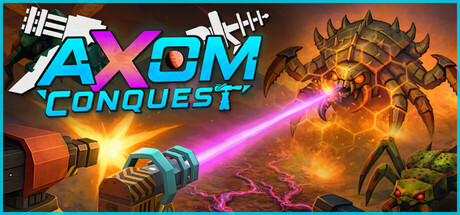
Tower defense keeps mutating. Every few months somebody bolts on a roguelite layer, a base-builder layer, a physics layer, an autobattler layer, and most of these hybrids die quietly on Steam two weeks after launch because the audience for "TD plus four other things" is narrower than the pitch decks suggest.
Hairy Penguin's Axom: Conquest, available on Steam, is one of those chimeras. It's also one of the more interesting ones I've seen this year, mostly because the studio seems to actually know which two audiences it's writing the love letter to: hold-out TD obsessives, and roguelite build-breakers.
Stripped of marketing varnish, the pitch goes like this. You defend a Nexus Drill on a procedurally-generated alien planet. You expand outward to grab resources. You try not to get eaten by physics-driven swarms of Centurax while the terrain itself slowly corrupts into hostile turf. Four difficulties, endless mode, a meta-progression research tree. And, per the developer, a tiny robot named Jeff.
Hold-out TD, but the map is squeezing you
The thing that separates Axom from the wave of They Are Billions descendants and Bloons-with-extra-steps clones is the infection mechanic. Tiles get corrupted over time. You can't just turtle behind a wall of bowling towers (yes, bowling towers) and farm forever — the planet itself is closing in.
That one decision quietly rewrites the optimization problem. Hold-out TD usually rewards perimeter-perfecting; here you're forced to keep extending refineries, cleansing ground, moving. It's the same tension that made Frostpunk work, dropped into a genre that historically lets players ossify into a single ideal layout.
Whether the swarm physics actually hold up under thousands of units is the part nobody outside the developer can confirm yet. Physics-driven crowds are a known performance trap. Plenty of indies have promised "thousands of units" and shipped with a frame-rate cliff at unit count 400. The preview coverage circulating on YouTube — the German strategy creator, the dad-gaming review channel, the smaller "honest review" types — has been treating Axom as a genuine sleeper rather than a tech showcase, which suggests the build at least runs. Stress-testing endless mode on mid-range hardware is the kind of thing that gets discovered in week two of launch, though.
Build-breaking as the actual point
The Steam copy openly courts "strategy fans who love breaking games with overpowered builds." Niche statement. Smart one. It tells the Vampire Survivors / Brotato / Slay the Spire overlap crowd that the math here is meant to be exploited.
Structure variants — double barrels, nuclear ammo, the alternate-powered versions of base towers — only matter if the underlying scaling actually allows for the snowball moments those players are chasing. Dozens of starting Nexus classes with distinct abilities, branching tower trees, upgrade chains, alien upgrades, consumables. This is the language of a designer who's spent serious time inside the run-based strategy subgenre and knows the dopamine isn't in the win. It's in the moment a build clicks and the screen turns into chaos.
The risk is balance. Roguelites that promise "every run is truly unique" through interlocking systems also tend to ship with three god-tier builds and twenty traps. Whether Hairy Penguin can tune around that as a small operation is an open question. The 2026 date gives some runway. But TD-roguelite balance is notoriously a post-launch problem — see basically every game in the genre's first six months on Steam.
The studio question
Hairy Penguin's web presence is, frankly, sparse. A Google Sites page. A press kit link. A contact form. No team bios, no tech blog, no dev diaries surfaced through the official site. Not a knock — plenty of strong indies ship with a one-page site — but it means almost everything verifiable about the game lives on Steam, the trailers, and the handful of preview videos from mid-tier strategy creators. No public engine disclosure, no roadmap document, no open beta sign-up. For a game leaning on physics swarms and procedural generation, the absence of any technical write-up is a missed shot at the strategy-curious audience that reads those things.
2026 is going to be crowded
The TD-roguelite shelf will be packed by next June. Mighty Yell's stuff, the constant stream of Steam Next Fest debuts, plus whatever the They Are Billions-adjacent crowd ships. Axom's differentiators — the corrupting terrain, physics swarms, build-breaking math, the offbeat tower roster — are real. They're not so loud that the game wins by simply existing.
It'll win or lose on the first 48 hours of launch-week visibility, which for an indie this size is almost entirely a function of who's covering it and how aggressively the wishlist count was built in the year prior.
And that's the marketing reality every studio in this corner of Steam is staring down. A hold-out TD roguelite with physics swarms and a build-breaking ethos is not a game you sell to "gamers." Trying to push it through broad-spectrum gaming media or generic influencer mass-blasts is how indies torch a marketing budget for 12,000 impressions and 40 wishlists. The audience that actually converts here is narrow and identifiable — roguelite-deckbuilder and survivors-like creators who livestream build optimization, the They Are Billions / Diplomacy is Not an Option base-defense streamers, the small but rabid auto-battler-math YouTubers, and the strategy-creator tier the preview videos already hint at (the German-language strategy scene, the mid-size "honest review" channels). Infrastructure like CreatorFetch is built for exactly that targeting resolution: surfacing those specific TD-roguelite creators by audience composition rather than raw subscriber count, so the keys go to people whose viewers are already pre-sold on the genre, instead of a generic 200k-sub channel that covers the game for one video and bounces.
Wishlist if the pitch lands for you. Skepticism is fair otherwise — a lot of this genre overpromises and underships, and a June 2026 date is far enough out that the build people are reacting to now isn't the build that'll ship. But the instincts on display, especially the terrain corruption pressure and the open invitation to break the math, are doing something the average TD-roguelite isn't even attempting.