
Foundation Typer
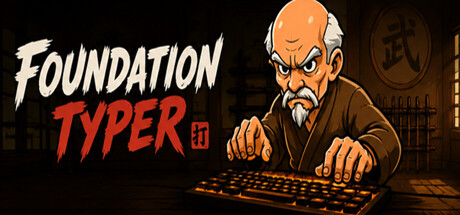
A typing trainer that thinks it's a kung fu movie
Typing tutors are a graveyard. Mavis Beacon ate the 90s, TypingClub and Monkeytype split the browser era, and pretty much every paid desktop attempt since has died quietly somewhere in a Steam new-releases queue nobody scrolled to the bottom of. So when a solo dev going by Bladevampirek announces a martial-arts-themed typing dojo for June 2026, my honest first reaction isn't excitement. It's: who is this for, and why would they pay for it?
That's the lens I'd use on Foundation Typer. Listed on Steam with a June 9, 2026 release, Foundation Typer pitches itself as something narrower and weirder than the usual WPM-chasing software — a structured curriculum built around belt progression, finger-specific drills, and a fictional sensei named Sifu Key-Ro who hands out fortune-cookie lines like "A calm typist defeats a frantic one."
Easy to laugh at. Also, probably, the most interesting marketing angle a typing app has tried in years.
What's actually in the box
Strip the dojo paint off and the program underneath is a pretty classical typing curriculum. Guided beginner lessons. Finger-specific training, so the pinky on the semicolon actually gets reps instead of being a forgotten coward. Real-time WPM and accuracy tracking. Problematic key detection — and that's the feature separating real typing tutors from PowerPoint decks with a textbox. Practice modes. Custom text input. Graduation challenges gating progression between belts.
The stated target is "stable, confident typing speeds of 35+ WPM." Modest, in a market where every competitor brags about pushing you into 120-WPM Monkeytype leaderboard territory. And the audience Bladevampirek calls out — complete beginners, self-taught typists with bad habits, students, gamers — is the audience that actually benefits from going back to the foundation. People already cruising at 90 WPM don't need a dojo. People stuck at 22 WPM who can't figure out why their left hand hates them, do.
The key rollover thing
One detail worth pulling out: the official project URL contains "KeyRolloverTyping," and the Steam copy explicitly mentions "key rollover concepts" as part of the training. Small signal. Real one, though. Key rollover — a keyboard's ability to register simultaneous keypresses correctly, and a typist's ability to overlap finger movement instead of fully releasing one key before hitting the next — is something serious typists and mechanical keyboard nerds obsess over, and almost no typing tutor actually teaches it.
If Foundation Typer really builds drills around rollover and overlap timing instead of just clocking raw WPM, that's a technical hook that separates it from the freeware crowd. If it doesn't, and "key rollover concepts" turns out to be a marketing phrase bolted onto standard letter drills, the exact audience most likely to buy it will catch on fast.
Early signals from creators
Not much to go on yet — the game's nine months out at time of writing — but one channel (Tech 01001010 01101111 01100101, which is "Joe" in binary, for the curious) has already posted a run through lessons 1–7 and a graduation test at "3rd Dan" performance. Niche of a niche. Someone documenting their belt progression like it's a speedrun. And that's exactly the kind of content that, in theory, makes this software work as a long-tail thing. Typing tutors live or die on whether learners post progress videos and drag friends in. The belt system gives those videos a spine.
The rest of the YouTube noise around "Foundation" is, predictably, makeup foundation tutorials and an unrelated mobile game called Foundation: Galactic Frontier. Brand-search disambiguation is going to be a problem. Anyone Googling this without the word "typer" lands on contouring tips.
Where the skepticism lives
The honest worry isn't whether the curriculum works. Structured typing drills with finger isolation and accuracy gating have worked for forty years. That pedagogy is solved. The worry is whether paid desktop typing software has any market on Steam in 2026, when Monkeytype, Keybr, and TypingClub exist for free in any browser tab.
The answer, if there is one, is theming and structure. Free browser tools dump you into an endless test field and let you flail. No sensei. No belts. Nobody telling you accuracy is honor. Which sounds ridiculous on paper — but gamifying skill acquisition is the entire reason Duolingo became a multi-billion-dollar company while every free language site stayed small. People will pay for a story wrapped around their reps.
Whether Bladevampirek has the production polish to make the dojo feel like a place and not a stock-asset menu — that's the real question, and nothing in the available material answers it. The Discord-hosted official site is a single-page React shell. No screenshots. No docs. No community FAQ. Normal for a solo dev nine months out. Also a void where the trust-building should be happening.
The marketing problem
Selling Foundation Typer to "everyone who types" is how this project dies in obscurity. A mass-market push for paid typing software in 2026 means competing for attention against free tools that already own the keyword space, against a Steam algorithm with no clue where to file a typing-tutor-as-martial-arts-RPG, and against a general audience that won't pay for software they assume Windows should include for free.
The realistic survival path is finding the small, intense pockets of people who already care about typing as a craft. Mechanical keyboard hobbyists arguing rollover and switch actuation on r/MechanicalKeyboards. Competitive Monkeytype racers chasing 150 WPM. Programming streamers whose chat won't stop roasting their typos. Language-learning YouTubers who occasionally drift into keyboard layouts. Productivity creators orbiting Obsidian and Notion. And the surprisingly large pile of speedrun-adjacent streamers who'd absolutely film a "can I hit black belt in one stream" challenge.
Reaching those people one by one is brutal manual work, which is where something like CreatorFetch slots in — a way for a solo dev like Bladevampirek to actually find and contact the keyboard hobbyists, typing racers, and skill-grind streamers whose audiences are pre-sold on this exact thing, instead of torching the launch on a generic press blast that lands nowhere.
Verdict, such as one can exist nine months out
Foundation Typer is going to be one of two things. A cult favorite among keyboard nerds who appreciate that someone finally built a curriculum around rollover and rhythm instead of raw speed. Or a charming solo project that picks up twelve reviews and vanishes. The theming is strong enough to carry it if the drills hold up. The market is hostile enough that nothing's guaranteed.
Working in its favor: a clear philosophy (accuracy before speed, control before flash) and a target user — the 20-WPM self-taught typist — who's genuinely underserved by everything currently free in the browser. Working against it: every other typing tool ever made, plus a name that collides with cosmetics tutorials in search results.
Worth watching when June 2026 rolls around. Worth staying skeptical until then.