
How to Make an Atomic Bomb in Your Garden
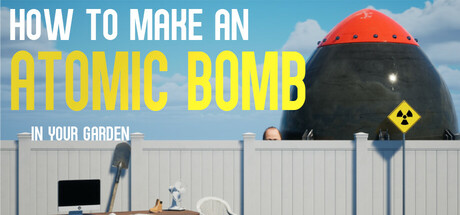
The DIY Nuke Sim Nobody Asked For
Every Steam Next Fest spits out one game that makes you stop scrolling and squint. For June 2026, it might be How to Make an Atomic Bomb in Your Garden, a single-player sim from solo-credited dev karahan, now sitting on Steam with a premise so deliberately stupid it loops back to interesting.
The pitch, stripped of marketing-speak: you're a guy in a backyard. You decide, for reasons the game can't be bothered to justify, that today's the day. So you fundraise. You bid on auctions. You pull fissile material out of household junk. You keep the neighbors guessing and the IRS off your back. Three stages. Somewhere between half an hour and three hours of total playtime, depending on how badly you flub the chemistry.
What the demo actually shows
The public demo is short. Painfully short, if you ask the creators who've already filmed it. Several mid-tier let's-players in the 10k–100k range — plus at least one German channel — all landed on the same gripe: you get a taste of the fundraising mini-game, a sliver of the parts-hunting loop, and then the curtain drops right when you're getting hooked. One creator built his whole video around the bit that his wife wanted a pool and he was building this instead. The joke writes itself. Which is half the appeal and half the problem.
What the footage does establish is tone. Not horror-comedy. Not Papers, Please dread, even though the IRS-avoidance system flirts with it. It's closer to the absurdist task-sim lineage, where the joke is the verbs themselves. You're not "crafting." You're solving atomic equations using cereal boxes. That distinction matters more than it sounds like it should.
The mechanical skeleton
Underneath the gag is a pretty conventional three-act progression sim with four interleaved systems: a fundraising mini-game (described as a "charm and hustle" test, which sounds suspiciously like a rhythm-or-persuasion loop), an auction/shopping layer for blueprint parts, a math/extraction puzzle layer, and a stealth meter tracking neighbors and federal scrutiny. Plus a stress system with "increasingly unhinged coping mechanisms" — a phrase that either means brilliant emergent comedy or one meditation animation reused twelve times. The demo isn't long enough to tell which.
The risk is obvious. Games built on a single absurdist premise live and die on whether the verbs stay funny past hour one. House Flipper survived because the cleaning loop was satisfying on its own. Goat Simulator survived by being short. A 30-to-183-minute runtime suggests karahan knows exactly where the joke wears thin and is cutting before it does — honestly the smartest visible design call from the outside right now.
The disclaimer question
The store page has a "some elements are inspired by real-world nuclear formulas, do not try this at home" note that reads half-sincere, half-marketing. The kind of line that exists because somebody, somewhere, in some legal department, made a phone call. Whether the game contains anything close to real physics or whether the "atomic equations" are pure nonsense puzzles dressed in scary notation — no one's going to know until full release. My money's on nonsense, because anything else is a lawsuit waiting to happen, and karahan does not appear to have a legal team.
Where it sits
This is a tiny game from a tiny dev shipping into the most crowded month on Steam, carrying a premise that's going to get it either banned from advertising on half the platforms or hand-waved through, depending on which moderator's awake. A traditional push — paid social, banner ads, key drops to top-100 streamers — would either get bounced the second the words "atomic bomb" surface in ad review, or burn budget chasing audiences who'll quit the moment they realize it's a puzzle sim and not a power fantasy.
The realistic survival path runs through the exact creators who already picked up the demo organically. Mid-size absurdist-sim YouTubers. The Papers Please / Suck Up / I Am Your Beast crowd. German let's-players who built audiences on weird Steam finds. Streamers whose chats live for premise-driven one-session games. CreatorFetch is the kind of tool that lets a solo dev like karahan actually map that audience — find channels already covering simulators with an edge, filter against the demo coverage that's already happened, and ship keys to people whose viewers will tolerate (and share) a premise the ad networks won't touch.
The honest read
Too early to call this anything. The demo's too thin, the systems aren't proven, and the premise could age beautifully into a cult favorite or curdle into a one-streamer-cycle joke nobody remembers by August. But there's a specific kind of craft visible even in the limited footage — the willingness to commit to the bit, the short runtime that respects the player, the absence of crypto winks or AI-slop assets — that suggests karahan is at least making the game on purpose. Whether on purpose is enough, June 2026 will tell.