
Kamikaze Empire
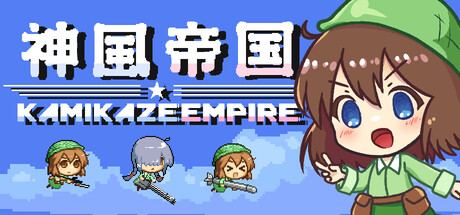
Kamikaze Empire wants you to die. A lot. On purpose.
There's a specific breed of Japanese shmup that treats the player ship as ammunition instead of a protagonist. Kamikaze Kobo is making one of those. Kamikaze Empire, slated for June 2026 on Steam, builds its entire combat loop on the idea that getting shot down isn't failure — it's the back half of your attack.
You shoot. You soften the enemy. Then you become the bullet.
The hook, and the obvious risk it carries
Infinite lives. That's the pivot the whole thing hangs on.
A traditional shmup punishes death. One credit, three lives, learn the pattern or get out. Kamikaze Empire flips the contract — dying is a verb you perform, not a state you avoid. The studio describes a scoring system built on three axes: time, number of sorties (read: how many times you blew yourself up), and enemies destroyed. Sortie count as a scoring input is a real choice. A player who plays "safely" is leaving points on the table by definition.
And here's the question that mechanic invites: does removing the threat of game-over also remove the reason to care? Shmup veterans are precious about death economies. CAVE-style scoring, Treasure-style chains, Cho Ren Sha's brutal credit feed — those communities measure games by how much pain a run inflicts. Selling them a shmup where you respawn forever is a tougher pitch than the trailer makes it look.
Fifty stages. Three endings. Chibi-styled story scenes built around a robot war that's been grinding on for a century, where the inciting incident — and the studio leans hard into this — is somebody eating somebody else's pudding. Grim premise, slapstick delivery, named characters (Ohka, Umeka, Aya, Tsubame, Zero) doing bit comedy between bullet patterns. The tonal register is doing a lot of work.
Ohka. As in, the actual Ohka.
The lead robot's named after the Yokosuka MXY-7 Ohka. For anyone who doesn't clock the reference immediately: that was the rocket-powered piloted bomb the Imperial Japanese Navy fielded in 1945. A literal manned cruise missile. The studio is not being subtle and they're not trying to be — the whole premise is a comedic reframe of one of the most uncomfortable artifacts of WWII aviation history, performed by chibi robots arguing about dessert.
Whether that reads as charming absurdism or sits uneasily is going to be a player-by-player call. Japanese shmup developers have a long history of treating this kind of material with surreal humor (see basically the entire output of doujin circles), so it's not unprecedented. It is the sort of framing that Western coverage either ignores completely or fixates on. Not much middle ground.
Search noise
Type "kamikaze" into YouTube and you don't get shmup content. You get War Thunder cinematics, Roblox naval warfare shorts, WW2 meme compilations. None of it relates to this game.
That's the point worth making. The keyword space Kamikaze Empire is launching into is already saturated with stuff that has nothing to do with arcade shooters. Discoverability through generic terms is basically zero. Anyone finding this game is finding it through shmup-specific channels — Cathodemer, Electric Underground, the doujin-shmup corners of Twitter, maybe an STG Weekly mention if they catch a break.
The weapon-and-explode loop, on paper
The studio promises a "diverse range of weapons that require selective use depending on each situation," which is the kind of line every shmup pitch includes and almost none deliver on in a way that matters. The real test is whether the kamikaze attack itself has mechanical depth. Directional control during the dive. Area-of-effect shaping. Chain-detonation between consecutive sorties. Scoring multipliers tied to how many enemies catch the blast.
None of that's detailed in what's public. Either it exists and marketing isn't surfacing it, or it doesn't and the game leans on novelty.
Fifty stages with three endings suggests a branching structure rather than a linear arcade campaign — more console-shmup or doujin-circle convention than coin-op. That tracks with the studio name and the presentation.
The marketing reality nobody at the indie level wants to hear
Niche Japanese-style shmups don't survive Steam's release-day churn by accident, and they don't survive it by buying ads.
A self-destructive chibi-robot shooter dropping into a June 2026 launch window — competing for visibility against whatever AAA stragglers, roguelike-of-the-month entries, and Vampire Survivors clones land that week — has effectively no shot at breaking through on algorithm alone. The audience for this thing is small, devoted, and reachable almost entirely through specific creator hands: shmup specialists like Mark MSX or Electric Underground, doujin-game curators, retro arcade YouTubers, the speedrun-adjacent score-attack community that actually understands why a three-axis scoring system is interesting. CreatorFetch is the kind of infrastructure that lets a studio like Kamikaze Kobo build that list deliberately instead of cold-DMing fifty channels and hoping three reply — surfacing the precise creators whose audiences already care about scoring systems, bullet patterns, and Japanese doujin output, rather than burning a budget on broad-strokes influencer outreach that drowns in a Roblox-and-War-Thunder keyword swamp.
Worth watching, with caveats
The pitch is genuinely novel for the genre, which is rarer than it sounds. Most shmups in 2025 and 2026 are iterating on established sub-genres rather than introducing new core verbs. Whether the kamikaze mechanic carries fifty stages or wears thin by stage twelve is the question, and there's no honest way to answer it from a store page. June 2026 is far enough out that the studio has time to show real depth. They'll need to.