
MAGE: Mega Awesome Gregarious Encounters
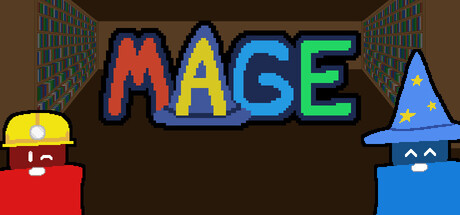
One stick, three buttons, twenty-one wizards
Most 2D party fighters live or die on a single question. Can four people who've never touched the game figure out what's happening on screen within thirty seconds?
MAGE: Mega Awesome Gregarious Encounters bets its entire identity on a control scheme so stripped-down it almost sounds suspicious. It's coming in 2026 from a four-person outfit called FunRug Studio. One stick. Three buttons. Twenty-one wizards trying to vaporize each other.
The page is sitting on Steam right now with a June 23rd, 2026 release date. The technical hook is genuinely interesting if you've ever wrestled with the input bloat in a modern fighter.
How the combat actually works
Left stick aims the wand. Right trigger shoots in that direction. Left trigger boosts the opposite way. That's the whole movement-and-offense layer. No jump button, no dedicated dash, no second analog stick managing a camera or a secondary weapon.
Aim and propulsion share the same input, which means every shot doubles as a recoil dodge in the opposite direction. Clever piece of design economy. The kind of constraint that quietly forces players into flickshots and last-second redirects without ever telling them to.
Then there's the Counterspell. Time a button press right as an attack lands and you siphon the opponent's magic, turning their incoming projectile into your own oversized retaliation. Which they can, of course, siphon right back. FunRug is openly leaning on a parry-and-reverse loop, and on paper that's where the skill ceiling lives.
Whether the netcode and hit confirmation can deliver consistent counterspell timing online is the open question. Local couch play will almost certainly feel sharper. Four-player party fighters have a long history of feeling fine right up until two people are on bad Wi-Fi.
About the roster
Twenty-one characters in a game with three inputs is a real design problem. The studio's documentation calls out specifics. Wind Mage redirects projectiles mid-flight. Plant Mage (called Nature Mage on the Steam page, which is a small inconsistency worth flagging) has a grappling hook. Moon Mage flips gravity off. Those aren't cosmetic differences. They're rewriting what "shoot toward your wand" actually does.
That's the right instinct. If all 21 mages just reskinned the same projectile arc, the roster would collapse into tier-list discourse inside a week. By changing the physics of the core verbs character to character, FunRug is essentially building 21 micro-games inside one input scheme. Ambitious. Also the kind of ambition that frequently produces five great characters and sixteen forgotten ones in indie fighters. The real proof is how often each mage shows up in player-recorded matches six months after launch.
That 200-map number
Ten environments, 200 maps, toggleable in any combination. The math works out to roughly twenty maps per environment, which suggests heavy use of layout variants on shared tilesets rather than 200 fully bespoke designs. Not a knock. Smash Remix and Rivals of Aether both proved that aggressive map variation, even on familiar art, keeps party fighters from going stale.
The toggling matters more than it sounds. Letting a group lock the rotation to "only Moon stages" is exactly the kind of granular party-mode control hosts of weekly game nights actually use.
What's catching on so far
Looking at FunRug's own channel and the scattered creator clips floating around, the focus has been on gamemode reveals tied to Next Fest and short, viral-format clips showing off counterspell exchanges and accidental chaos. They're clearly leaning into the highlight-reel side of the game. Smart move. Party fighters live and die on clip-ability.
The Next Fest demo also gave away a substantial chunk of the game for free, which the studio openly framed as "half" of it. That's an aggressive demo strategy from a four-person team. It suggests they know discovery is their real enemy, not retention.
The hard part nobody talks about
FunRug describes itself as four close friends learning game dev together. Charming. It's also a structural reality that shapes everything about how this game can reach an audience.
A 2D projectile party fighter in 2026 is dropping into a genre where Rivals 2, MultiVersus, Brawlhalla, and a constant churn of indie brawlers are all fighting for the same eyeballs. A generic "wishlist us!" campaign across TikTok and Twitter is the path most small studios take. It's also the path that produces 200 wishlists and a launch-day cliff.
The realistic survival play for something like MAGE isn't broad reach. It's surgical placement in front of the exact creators whose audiences already love this specific texture of game. Local-multiplayer YouTubers who build content around four-player couch sessions. Fighting-game tech channels willing to actually break down counterspell timing. Party-game streamers who run weekly viewer lobbies. Plus the smaller pixel-art indie-coverage corners that still genuinely care about a roster of 21 hand-animated wizards.
Trying to put the game in front of a general gaming audience would burn the studio's tiny marketing budget on indifferent impressions. Tools like CreatorFetch exist precisely so a four-person team can identify those specific creator pockets and get keys into the right hands without spending three months cold-emailing inboxes that never open.
Should you care yet?
If you run a regular game night and you've worn out Duck Game, Stick Fight, or TowerFall, MAGE is sitting in a lane worth tracking. The single-stick idea is genuinely fresh. The counterspell loop has the right kind of escalation. And 200 maps with full toggling is the sort of feature small studios usually cut first.
Whether the 21-mage roster holds up under real competitive scrutiny, and whether online play feels as crisp as the local pitch, those are the things to watch when the next demo cycle comes around. June 2026 is far enough out that FunRug has time to fix what needs fixing. It's also far enough out that the discovery problem only gets harder.