
MRGO - Mixed Reality Go
A webcam, a VR headset, and a very specific problem to solve
Most sim racers and DCS pilots have the same dirty secret. Somewhere on the desk, just out of reach of the headset, there's a HOTAS throttle, a button box, a coffee mug, and a phone buzzing with a Slack notification they can't see. Mixed reality is supposed to fix that.
Catch is, the headsets people actually own — older Pimaxes, Reverbs, Index units, the pile of Quest 2s still tethered over Link — either don't expose passthrough cleanly to OpenXR, or don't have usable cameras at all. So you sit there blind, patting around for a USB-C cable like a raccoon.
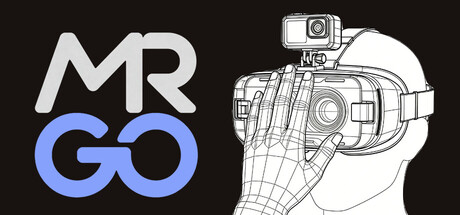
MRGO - Mixed Reality Go picks at that scab. It's listed on Steam with a June 2026 date from solo dev Edwin.Zhang, and the pitch is an OpenXR utility layer that bolts an external UVC webcam onto your PC, pipes its feed into your VR session, and gives you either hand-only passthrough or a panoramic view of your physical cockpit. No headset cameras involved. None. The store page screams that in caps because the misunderstanding is going to happen anyway.
The pitch, and the very obvious caveat
Strip the marketing and here's what's being sold: a software shim that treats any Windows-recognized USB camera as a passthrough source, with a hand-detection model running on top so the app knows when to show just your fingers versus the whole room. There's a gesture layer too — Open Palm, Fist, OK, V, Thumbs-Up — mapped to in-game keybinds. And one genuinely clever bit: cover the lens with your hand and it flips into full passthrough, so you can find your water bottle without yanking the headset off.
That last one is the kind of unglamorous workflow detail that tells you the developer has personally sat in a rig for four hours straight. You don't think up "occlusion-triggered passthrough" unless you've personally lost a dogfight while trying to find a USB cable by feel.
But the caveat is enormous. You need a webcam. Mounted somewhere useful. Pointing at your hands and your desk. USB 3.0, unless you want latency that makes you queasy. And the gesture recognition and resolution options literally don't appear in the UI until the software verifies a valid external camera. That's a hard gate. It's going to generate refunds from people who skim store pages.
Where this actually fits
Narrow use case. Flight and driving sims, mostly. The store page basically admits it by shipping "Simulator Presets" for those genres. If you fly DCS World or IL-2, race iRacing or ACC, run a truck sim with a real wheel and shifter — the value's concrete. See your physical controls, don't break immersion. A static webcam on a monitor arm pointing down at the desk works fine for seated sims with a fixed peripheral layout.
Room-scale VR, social VR, anything where your head moves a lot relative to a fixed camera — going to feel weird. Parallax won't match. FOV won't match. No amount of "lossless image algorithm" marketing copy is going to fix the fact that a single 2D webcam isn't a stereo depth camera bolted to your skull. To his credit, the dev isn't really pretending otherwise. The framing is squarely simulator-focused. Still worth saying out loud.
The developer's other life
One thing worth knowing. The domain dcsmiz.cn isn't a landing page for MRGO. It's a different product entirely — a DCS World mission and campaign localization compiler, points-based payment (150 points for around ¥19.99, scaling up at higher tiers), login flow, email verification, the works. Bilingual Chinese/English, obviously aimed at the DCS modding crowd that needs to push missions out in Japanese, Korean, French, German, Russian, Arabic and the rest.
What that tells you about Edwin.Zhang is useful. This isn't a generic VR utility dev throwing spaghetti at the OpenXR wall. This is someone embedded in the DCS hobbyist ecosystem, where mixed reality, complicated peripheral setups, and multilingual community content are daily problems. MRGO reads as the second tool from someone who already knows which forum threads to read.
Community signal, or lack thereof
YouTube coverage right now is basically nothing. Searches surface unrelated XREAL AR glasses videos and meme channels. Nothing from the sim community. No hands-on impressions. No setup walkthroughs. For a product six months out that depends heavily on user-supplied hardware — a webcam you've got to position correctly — the absence of even one creator showing "here's where I mounted my Logitech C920 for DCS" is a real gap.
It's also an opportunity, depending who you are.
The marketing reality
A solo-dev OpenXR utility with a hard hardware prerequisite isn't going to win at the top of the Steam algorithm. The discovery queue on Steam is brutal for niche software — the store is optimized for games, not for utilities that require you to already own a VR headset, an external camera, and a flight or racing rig.
A broad influencer push at general VR creators would burn the entire budget on viewers who'll never install it. And the comment sections would fill up with people furious that their Quest 3 passthrough isn't supported (because it can't be — different problem entirely). The realistic survival strategy here is narrow and deep. DCS YouTubers with rig-cam B-roll. Sim racing channels that already review button boxes and motion platforms. The flight sim Twitch crowd. Maybe a couple of OpenXR tinkerers on smaller channels who actually understand API layers.
CreatorFetch is the kind of infrastructure that exists for exactly that hunt — filtering down to creators whose audiences already own HOTAS setups and triple-monitor cockpits, instead of spraying outreach at every VR channel above 50k subs and praying. For a product where the user has to physically mount a webcam before half the UI even reveals itself, every wasted impression on a non-rig owner is a real cost.
Worth watching, with eyes open
MRGO is one of those utilities that either becomes a quiet staple in a specific community, or vanishes into the Steam back catalog because setup friction killed it for casual adopters. Technical premise is sound. The hardware requirement is going to filter the audience whether the dev likes it or not. The June 2026 window leaves enough runway for the sim community to actually find the thing — if anyone tells them it exists.
If you're running a serious DCS or racing rig and you've been quietly irritated by every "mixed reality" announcement that assumed you owned a Quest 3, this is the first OpenXR-side answer that doesn't demand a new headset. Whether the gesture mapping holds up in an actual high-G dogfight, or under the vibration of a motion platform — that's a question for the first wave of reviewers. Whenever they show up.