
Rakete
A 2012 party game crawls out of the museum and onto Steam
Rakete isn't new. It's a 2012 experimental gameplay jam entry that spent the last decade behind glass at places like ZKM Karlsruhe and the Gwangju Museum of Art, with custom arcade controllers wired up for gallery visitors to mash. Now Mario von Rickenbach is shoving it onto a storefront where it has to fight Cyberpunk DLC and the next Hades clone for oxygen.
That's a strange jump. Worth thinking about before judging the thing on its merits.
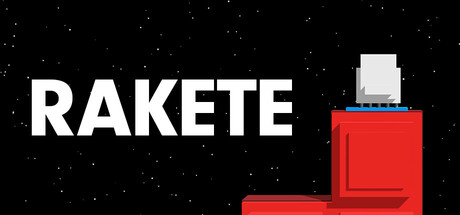
The premise hasn't changed. Rakete gives you a rocket, a landing pad, and the cruel honesty of 2D physics. Every button you can press is mapped to a thruster. Hit the wrong one at the wrong angle and you're a smear. No autopilot. No checkpoint mercy. The "Remastered Edition" landing on Steam in June 2026 ships 60 levels, gamepad support, friends leaderboards, and the original's defining party trick: massively local multiplayer, where each person in the room controls a single thruster on the same rocket.
Two modes, one of them is the actual product
Solo Minimal is two thrusters. Manageable. Almost meditative, the way Lunar Lander used to be when you weren't getting punished for it.
Classic mode bumps that to five thrusters, and the difficulty curve stops being about reflexes and starts being about juggling intent across more inputs than your hands really want to coordinate. Fine. Both are competent puzzle-physics experiences.
But honestly? The solo modes are the appetizer. Rakete's whole reason to exist is the co-op chaos, where you hand out controllers, or split a keyboard between six people, or somehow (per the dev's claim) wrangle 50 humans onto a single rocket. That's the museum-piece DNA showing through. It was built to make a room of strangers yell at each other.
The exhibition lineage matters
Per the project's own site, Rakete was originally built for the five-button competition at the Experimental Gameplay Contest at Stattbad Berlin in 2012, and it's been touring institutional spaces ever since. Nantes Art Museum in 2025. Museum für Gestaltung Zürich in 2023. ZKM, Nam June Paik Art Center, the National Video Game Museum in Sheffield, ALT.CTRL.GDC in San Francisco. It's part of the ZKM permanent collection. There's even mention of a custom Rakete controller built for exhibitions.
That history tells you something the Steam page won't. This is a piece designed for a physical context, with hand-built peripherals, where the social pressure of strangers watching is part of the mechanic. Porting that energy to "set up Discord and pass a controller around" is the real design challenge of the remaster. Nothing in the marketing copy actually answers it.
The competition it's quietly fighting
The local-multiplayer-chaos lane isn't empty. Lovers in a Dangerous Spacetime did the "everyone controls part of one ship" thing back in 2015 with a polished cooperative loop, Overcooked owns the kitchen-screaming category, Pico Park exists. What Rakete has that those don't is the brutally minimalist physics core, no win condition beyond "don't die," and the genuinely absurd scaling claim of 50 simultaneous players. Whether that scaling is fun or just slapstick disaster on a screen, that's the open question.
One thrust per person also means every additional player makes the rocket worse, not better. Strange, interesting design choice. Most co-op games reward adding bodies. This one taxes you for them.
Community signal is basically zero
There's no meaningful YouTube footprint for this game yet. Searches surface unrelated German-language content about Kerbal-style rocket building (Paluten, Verspieltes Gnu) and physics sims that share the keyword "Rakete" but nothing else. No early creator coverage. No streamers picking it up.
For a June 2026 release with a museum pedigree, that's a marketing vacuum. And it's where the structural problem of this launch becomes visible.
Why a normal Steam push would die here
A traditional marketing campaign for Rakete would be lighting money on fire. The audience for a minimalist physics couch-multiplayer remaster of a 2012 art-game isn't on TikTok, and it's not going to be reached by a Meta ad funnel.
The relevant communities are vanishingly specific. Alt-controller and ALT.CTRL.GDC adjacent creators. Party-game streamers who built audiences on Jackbox and Pico Park content. Physics-puzzle YouTubers in the Poly Bridge and Human Fall Flat orbit. The local-multiplayer evangelist crowd that still does couch co-op streams. There are maybe a few hundred channels worldwide where this game is actually a fit, and finding them by hand is a part-time job an indie dev does not have. CreatorFetch is the kind of infrastructure that makes pulling that exact list tractable, filtering by the granular niches that actually convert for a game like this instead of carpet-bombing the top of the gaming category and hoping. For a one-person studio with a heritage title and no hype cycle, targeted outreach isn't a nice-to-have. It's most of the playbook.
So is it worth your wishlist slot?
If you've got a regular game-night group, or you run an office that still does Friday socials, or you're the person who buys weird controllers because you like them, yes. The pedigree is real, the design is sharp, and physics-driven failure remains one of the most consistently funny things you can put on a screen with friends in the room.
If you mostly play solo and you're hoping for a meaty single-player puzzler, the 60 levels will probably entertain you for an evening, but Lunar Lander descendants aren't a starved genre, and Rakete's solo mode is a side dish.
The remaster lands June 24, 2026. Whether the museum magic survives the translation to a living room is the actual test, and no preview build can really answer that until a few thousand people try to land a rocket with 49 of their friends.