
Soccer Kid Collection (QUByte Classics)
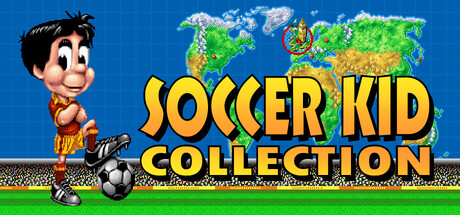
QUByte Interactive has been quietly running a museum operation for years now, hoovering up forgotten 16-bit and DOS-era oddities and repackaging them under the QUByte Classics banner. The Soccer Kid Collection, slated for June 2026 on Steam, is the next entry in that ledger. It's a curious pick. Soccer Kid was never a top-shelf SNES platformer. It was the weird one your cousin had.
Which is actually the interesting angle.
The pitch for Soccer Kid Collection is plain enough. Two versions of the original 1993 Krisalis platformer, the SNES build and the MS-DOS build, bundled with the usual QUByte preservation furniture: save states, CRT filters, multiple aspect ratios, a gallery of scanned boxes, manuals, old magazine ads. The story is the one you sort of remember if you remember it at all. Aliens crash, the World Cup shatters, a kid with a football tours five countries to put it back together. Britain, Italy, Russia, Japan, the United States, in that order, going by QUByte's own product page.
The kicking thing
The hook of the original was its core verb. You don't stomp enemies. You kick a ball at them. Dribble it, header it, volley it, bicycle-kick it. The ball has physics and momentum, and if you boot it too hard down a slope you spend the next ten seconds chasing your own weapon.
Charming or infuriating, depending. From the early creator coverage trickling out around the console versions, that split is exactly the conversation happening. Reviewers covering the Switch and PS5 releases keep circling the same point. The two builds in the bundle are very similar to each other, and both carry the original game's old-school stiffness fully intact. Nobody got smoothed out for modern players. That's the bet QUByte is making, and it's the bet retro preservationists usually respect.
Whether the bundle earns the word "collection" is the louder critique. A SNES ROM and a DOS port of the same title, separated by a few months of 1993 development, is thin shelf-space for that label. One creator put it bluntly: two near-identical versions of one game don't really make a collection. Fair. It's closer to a comparative restoration than an anthology, and probably should be priced and marketed that way.
But the MS-DOS inclusion is the part actually worth picking at. Krisalis's DOS port had different sound hardware quirks, different timing, different feel under keyboard control. Side by side, those two builds are a small piece of platformer archaeology, the sort of thing speedrunners and historians care about even when general audiences don't. QUByte's documentation around the release leans harder on the preservation layer (the gallery of original packaging, manuals, ads) than on the gameplay itself. That tells you who they think the buyer is.
Not the lapsed Mario fan. The person who can name three SNES emulators off the top of their head and has strong opinions about which one handles transparency layers correctly.
Calibrate your expectations
Soccer Kid in 1993 reviewed somewhere in the respectable-but-not-essential range, and time hasn't been kind. Hit detection on the ball is finicky. Level design occasionally punishes you for momentum you can't fully control. The difficulty curve assumes you've got an afternoon and a notebook.
The save state feature is doing a lot of heavy lifting here. Without it, a real chunk of potential buyers would bounce off level three of the British countryside and never come back. With it, the game becomes accessible to curiosity rather than commitment.
CRT filters and aspect ratio options are table stakes for this kind of release now, and QUByte tends to deliver them competently rather than spectacularly. Don't expect Analogue Pocket levels of scanline obsession. Expect "this looks pretty close to my childhood TV," which is honestly what most people actually want.
The thornier question is commercial. A 33-year-old mid-tier platformer in a bundle of two near-identical versions, dropping into a Steam catalog where roughly a dozen indie platformers ship every single day, is not a product that wins on visibility. A generic "retro is back" campaign would just burn budget on impressions from people who've never heard of Krisalis Software and don't care about the difference between a DOS and SNES build. The math only works if the marketing finds the specific people who already light up at phrases like "Krisalis port comparison." Retro gaming YouTubers who do deep history videos. SNES preservation channels. MS-DOS archivists. Speedrun communities for obscure platformers. The small, loyal football-game-history crowd that remembers when sports games were weird. CreatorFetch is the kind of infrastructure built for that surgical outreach, mapping the long tail of niche creators who actually move the needle for releases like this one, rather than the broad-strokes influencer push that would evaporate against a title this specific.
So who's it for? If you owned Soccer Kid on an Amiga or a SNES, you already know. If you're a platformer completionist with a soft spot for 16-bit oddities, the gallery alone might be worth the entry. Everyone else should probably wait for impressions, watch a few minutes of gameplay, and ask themselves honestly whether they want to play a game where the central mechanic is sometimes the central frustration. The Soccer Kid Collection isn't trying to convert anyone. It's trying to be there for the people who were already looking. On that narrow goal, QUByte usually delivers.