
Unrailed 2: Back on Track
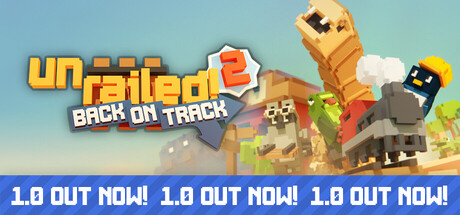
Unrailed 2 is the rare co-op sequel that actually understands what made the first one work
Co-op chaos games age badly. The genre is littered with sequels that confused "more stuff" with "more fun," piling mechanics on top of a clean original until the kitchen-table magic just evaporated.
Indoor Astronaut, the small Swiss studio behind the first game, seems to get this. Unrailed 2: Back on Track is sitting on Steam with a June 11, 2026 release date, and from what's been shown it looks less like a reinvention and more like a careful expansion of a formula that already had a rabid following.
The pitch hasn't moved much. You and up to three friends (or seven, we'll get there) mine, chop, craft, and lay track in front of a train that absolutely will not stop for you. Miss a rail, derail. Drop a bucket of water at the wrong moment, derail. Argue about whose turn it is to grab iron, derail.
The skeleton is identical. Everything around the skeleton is new.
The roguelite turn
The original Unrailed 2 was effectively a high-score chaser dressed up as a co-op puzzler. The sequel actually commits to roguelite progression this time. Six biomes, each with their own mechanics and a boss locking the junction to the next zone. Permanent character upgrades. Unlockable engines, wagons, cartridges that grant abilities. Cosmetics. The full loop.
The interesting wrinkle, pulled from the studio's own documentation, is a risk-reward toggle inside each biome. Stay longer, things get harder, rewards get better. Small decision, big implications. It means experienced crews self-select into pain. It means four people can argue, mid-run, about whether to push for one more upgrade or punch through to the next zone. Co-op games live or die on whether they generate that exact kind of friction. This one's engineered to.
For purists who hated the idea of progression creeping into a pure skill game, there's a Classic mode. New biomes, no bosses, no upgrades. A small concession, but a smart one. The kind of thing you only include if you actually listen to your Discord.
Eight players
The headline feature in the marketing is the 8-player Versus mode. 4v4, online leaderboards, action replays. On paper, a logical evolution. In practice, anyone who's tried to coordinate eight humans in a real-time co-op puzzler knows what's coming. Glorious dysfunction. Which is, to be fair, kind of the whole point. The first game was at its best when it was a screaming mess. Doubling the screamers is a defensible creative choice.
Whether the netcode holds up across eight clients running procedurally generated terrain is the question nobody can answer until launch. The studio hasn't published technical details on rollback, prediction, or peer-to-peer architecture. The footage circulating so far is mostly local couch sessions or single-platform showcases. Dengeki's Japanese coverage, the PlayStation launch trailer, a quick Switch gameplay capture. Surface-level stuff, not stress-tested. The deeper community questions about sync reliability, input lag at 8-player, and how Terrain Conductor maps perform with heavy custom geometry are still open.
Terrain Conductor is the sleeper
Buried under the co-op marketing is a level editor that, if it works, could carry this game for years.
Terrain Conductor lets players build custom maps and share them through what the website calls a browsable community catalog, with featured picks curated by the devs. User-generated content is the cheapest possible long-tail content strategy, and for a game where every run is procedurally generated anyway, the leap to "let players define the procedural rules" is short.
The risk is the obvious one. Tooling too shallow, you get a thousand variations of the same gimmick map. Too deep, casual players bounce off. The studio's bet seems to be a curated highlight system to surface the good stuff, which is a moderation workload they'll need to actually staff.
The competitive shelf is brutal
Co-op party-puzzle is crowded. Overcooked still defines the category for most players. Moving Out, PlateUp, Pico Park, the rest of the "yell at your friends" wave, all fighting for the same Friday night. Unrailed's original advantage was that its core verb, building track in front of a moving train, was mechanically distinct in a way "cook the orders faster" wasn't. The sequel inherits that. Whether the added roguelite layer dilutes the pure puzzle elegance or enriches it is going to be the central critical debate at launch.
Indoor Astronaut is also, by Steam-publisher standards, tiny. There's no Devolver-tier marketing engine behind this. Which makes the next part interesting.
The marketing problem nobody talks about
A game like Unrailed 2 has no business doing a broad TV-spot-style launch push, and the studio clearly knows it. Mass-market advertising for a chaotic 2-to-8-player co-op roguelite is money set on fire. The buying decision here isn't individual, it's social. Nobody buys this game alone. They buy it because they watched a streamer lose their mind playing it with three friends, or because their cousin showed them a clip at a party.
The conversion path runs through specific creator categories. Couch co-op YouTubers. Party-game streamers. The family-friendly Twitch crowd. Speedrunning communities (Time Attack mode is built for them). And the small but loyal Terrain Conductor map-maker scene that will inevitably emerge. Reaching those people takes surgical outreach, not impressions, which is roughly the gap that tools like CreatorFetch try to fill for a studio this size, helping them identify the precise creators whose audiences will actually buy four copies instead of one, without torching a quarter's budget on a single sponsored video that misses.
So, is it worth tracking?
If you liked the first Unrailed, this is an obvious wishlist. The progression systems address the original's main long-term complaint (runs got samey), the level editor gives it legs, and the co-op fundamentals look intact.
If you bounced off the first one because the real-time pressure stressed you out, nothing here is going to convert you. The studio isn't trying to.
The real test is June 2026, eight players, launch-day servers, a custom map somebody built the night before. If that works, Indoor Astronaut has a sequel that earns the subtitle. If it doesn't, well. There's a Classic mode to fall back on. They thought about it.